How can employers reduce workplace injuries and workers’ compensation claims in physically demanding jobs?
Employers can reduce workplace injuries and workers’ compensation claims by taking a proactive approach to workplace injury prevention. Key strategies include evaluating job applicants’ physical abilities pre-hire, identifying ergonomic hazards and mitigation strategies through ergonomic assessments, providing ergonomic training, encouraging early symptom reporting, and using return-to-work fitness for duty evaluations after injury recovery. Applied together, these measures help reduce MSD exposure, improve worker-to-job matching, lower reinjury risk, and create safer, more productive operations.
Work-related Musculoskeletal Disorders (MSDs) continue to be one of the biggest operational and workforce health challenges across physically demanding industries.
According to the Bureau of Labor Statistics’ 2026 report, private industry employers reported 2.5 million nonfatal workplace injuries and illnesses in 2024.
While the numbers are declining at a steady rate Although the total number of reported nonfatal workplace injuries and illnesses continues to decline, warehousing, transportation, manufacturing, and labor-intensive operational environments continue to report some of the highest exposure rates due to repetitive lifting, overexertion, awkward postures, and force-intensive work activities.
The first 90 days on the job are among the highest-risk periods for injury. New hires are often introduced to physically demanding workflows before they have fully adapted to the pace, understood the correct movement patterns, developed endurance, and know how to minimize the physical strain associated with the role.
Many organizations fail to evaluate job candidates’ physical ability and identify ergonomic hazards that contribute to cumulative physical stress across daily operations. As a result, employers face higher workers’ compensation costs, workforce instability, absenteeism, operational disruption, and preventable turnover during the earliest stages of employment.
Preventing these injuries requires more than reactive injury management after incidents occur. Employers need systems that determine whether workers are physically prepared to safely perform the demands of the role while also identifying workplace conditions that increase long-term MSD risk.
This is where pre-hire Physical Abilities Testing and ergonomic assessments become critical. The pre-hire tests help organizations determine whether workers can safely perform the documented physical demands of the role.
Ergonomic assessments focus on identifying ergonomic hazards such as repetitive movements, excessive force, awkward positioning, and workflow conditions that contribute to cumulative physical strain over time.
In this guide, we’ll break down five of the most common reasons new hires get injured during their first 90 days and the workplace injury prevention strategies employers can use to reduce injury risk, lower MSD exposure, and avoid larger workforce and operational challenges.
Here’s what we’ll cover:
- Hiring employees without an effective physical job-fit evaluation
- Exposure to ergonomic hazards that increase early-stage MSD risk
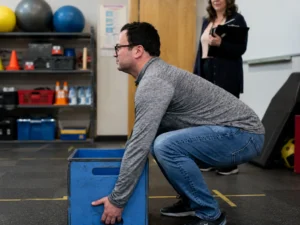
- Inadequate ergonomic training and unsafe lifting mechanics
- Delayed response to early musculoskeletal discomfort and fatigue
- Returning employees to work before they are physically ready
1. Hiring employees without an effective physical job-fit evaluation
What is it?
One of the leading causes of early-stage workplace injuries is placing employees into physically demanding roles without properly evaluating whether they can safely perform the documented physical demands of the job. Many organizations still rely on interviews, work history, self-reporting, or generalized screening processes that fail to assess lifting capacity, endurance, repetitive movement tolerance, and overall physical readiness before work begins, creating gaps in workplace injury prevention efforts.
As a result, employees may be assigned to tasks that exceed their functional capabilities, increasing the likelihood of fatigue-related incidents, musculoskeletal disorders (MSDs), and preventable workplace injuries.
Why does it matter?
- Poor worker-to-job matching increases MSD risk
- Workers’ compensation exposure rises because of preventable injuries
- Workforce instability creates operational disruption
- HR and safety teams become trapped in reactive injury management
- Recruiting and training costs increase because of turnover and absenteeism
Organizations without structured fitness for duty processes often struggle to consistently validate worker readiness before physically demanding work begins.
2. Exposure to ergonomic hazards that increase MSD risk

What is it?
Many workplace injuries develop gradually through repeated physical strain rather than from a single unsafe event. Repetitive lifting, awkward postures, twisting, excessive reaching, force-intensive tasks, and inadequate recovery place continuous stress on muscles, joints, and connective tissues over time, increasing the likelihood of musculoskeletal disorders (MSDs).
New hires are especially vulnerable because they are still adapting to unfamiliar workflows, movement patterns, productivity expectations, and physically demanding tasks. In many organizations, these issues go unnoticed until repetitive strain injuries, fatigue-related complaints, and injury trends begin to affect workforce performance and operational continuity.
Ergonomic assessments help organizations identify workplace conditions contributing to cumulative physical strain, including workstation layout, movement patterns, repetitive tasks, force requirements, and workflow inefficiencies that increase injury exposure across daily operations. As part of a broader workplace injury prevention strategy, these assessments help employers identify and address risks before they contribute to MSD development.
Why does it matter?
- MSDs often develop gradually through cumulative physical strain
- Repetitive strain injuries increase absenteeism and turnover
- Workers’ compensation exposure rises across operations
- Operational continuity suffers because of recurring injuries
- Safety and HR teams spend more time managing injury-related disruption
What are the most common ergonomic hazards in physically demanding jobs?
Common ergonomic hazards include:
- repetitive lifting
- force-intensive tasks
- awkward postures
- excessive reaching,
- twisting (especially with a load)
- repetitive motion
- poorly designed workflows.
Over time, these hazards place continuous stress on muscles, joints, and connective tissues, increasing the risk of musculoskeletal disorders (MSDs). Ergonomic assessments and implementation of countermeasures help employers identify and reduce ergonomic hazards. When ergonomic improvements are prioritized, strain exposure decreases, and the process supports safer task performance.
3. Ineffective ergonomic training and unsafe lifting mechanics
What is it?
Many organizations provide general workplace safety orientation but fail to standardize training around lifting mechanics, posture awareness, repetitive task execution, and body positioning during physically demanding work. As a result, employees often perform the same tasks using movement patterns that aggravate the musculoskeletal system, across teams, shifts, and locations.
New hires are especially vulnerable because they are still adapting to unfamiliar workflows and physical job demands. Without effective ergonomic training and reinforcement, repetitive lifting, force-intensive tasks, and improper body mechanics can gradually increase fatigue, overexertion, and cumulative physical strain across the workforce, undermining broader workplace injury prevention efforts.
Why does it matter?
- Poor lifting mechanics increase repetitive strain exposure
- Poor work practices create preventable injuries
- Workforce fatigue accelerates cumulative MSD risk
- Operational disruption increases as injury rates rise
4. Delayed response to early musculoskeletal discomfort and fatigue

What is it?
One of the biggest challenges in physically demanding workplaces is that employees often delay reporting early signs of physical strain. Symptoms such as soreness, stiffness, fatigue, reduced mobility, and mild discomfort are frequently ignored until they progress into more serious musculoskeletal disorders (MSDs) and lost-time workplace injuries.
In many cases, employees avoid reporting symptoms because they fear appearing weak, disrupting productivity, or losing work opportunities. As a result, minor physical strain can gradually escalate into recordable injuries, lost-time incidents, prolonged recovery periods, and costly workers’ compensation claims.
Without early intervention, organizations often remain trapped in reactive injury management cycles where safety, HR, and operations teams spend increasing amounts of time managing injury-related disruption, staffing shortages, and return-to-work coordination.
Early intervention programs must be OSHA-compliant to ensure they provide support to employees without discouraging or interfering with the reporting of work-related injuries and illnesses. A compliant early intervention program focuses on addressing discomfort and minor symptoms promptly, with OSHA’s first aid techniques, providing education and resources, and facilitating access to appropriate care when needed. As part of a broader workplace injury prevention strategy, this approach helps employers reduce injury severity, improve employee well-being, and maintain regulatory compliance while fostering a culture of safety and trust.
Why does it matter?
- Delayed reporting increases injury severity
- Claims duration and associated costs rise
- Productivity declines because of absenteeism or working with pain
- Workforce fatigue contributes to cumulative MSD risk
5. Returning employees to work before they are physically ready
What is it?
Medical clearance alone does not always confirm whether an employee is physically prepared to safely resume full-duty work. In physically demanding environments, workers returning after injury or illness may still lack the endurance, strength, mobility, or stamina needed to safely perform the documented physical demands of the role – even after medical management is complete.
When employees return before they are fully prepared for repetitive lifting, force-intensive tasks, awkward positioning, or sustained physical workloads, the likelihood of reinjury increases significantly. This often leads to extended recovery periods, additional workers’ compensation costs, workforce instability, and ongoing operational disruption.
Return-to-work fitness for duty evaluations help organizations determine whether employees are physically prepared to safely resume the documented physical demands of the role after injury recovery. As part of a comprehensive workplace injury prevention strategy, these evaluations focus on assessing physical readiness rather than relying solely on generalized medical release decisions.
Why does it matter?
- Reinjury risk increases without fitness for duty evaluations
- Workers’ compensation costs rise because of repeat injuries
- Workforce continuity suffers during incomplete recovery
- Productivity declines when employees return before they are ready
- Operations absorb additional staffing strain and overtime burden
Delayed or inconsistent fitness for duty decisions can increase return-to-work risk across physically demanding operations.
How do fitness for duty evaluations help prevent injuries in physically demanding workplaces?
Fitness for duty evaluations help determine whether workers can safely perform the documented physical demands of a role after injury or illness. By evaluating strength, endurance, mobility, and functional capability against job requirements, employers can reduce worker-to-job mismatches that often lead to early-stage injuries. Fitness for duty evaluations are also valuable when employees return after injury or illness, helping organizations confirm physical readiness before full-duty work resumes. When supported by job analysis and ergonomic hazard reduction efforts, they contribute to a stronger workplace injury prevention strategy.
How ErgoScience Helps Employers Reduce Workforce Injuries in Physically Demanding Jobs
Reducing first-90-day injuries requires more than reactive claims management or generalized workforce screening.
Employers operating in physically demanding environments need proactive systems that strengthen workforce readiness, reduce MSD exposure, and support safer operational performance across the employee lifecycle. Effective workplace injury prevention programs help organizations address these challenges before they result in costly injuries and operational disruption.
Through formal job analysis and job-specific Physical Ability Testing (PAT), ErgoScience helps organizations define physical job requirements and improve hiring accuracy through objective worker-to-job matching.
Ergonomic assessments, training, and early intervention services help employers identify ergonomic hazards, reduce workplace strain exposure, and lower cumulative MSD risk across daily operations.
Return-to-work fitness for duty evaluations help determine whether recovering employees are physically prepared to safely resume the documented demands of their role.
Backed by formal job analysis, peer-reviewed occupational research, validated workforce testing methodologies, and scalable multi-site deployment capabilities, ErgoScience helps employers strengthen workplace injury prevention efforts, improve workforce safety, reduce injury-related disruption, and create more consistent operational performance across physically demanding industries.
| Challenge | ErgoScience Approach | Outcome |
| High injury rates among new hires | Job-specific fpre-hire physical abilities testing | Fewer work-related injuries among new hires |
| Workforce instability and early exit | Better hiring evaluations | Improved retention |
| Reactive injury management consumes safety and HR | Early intervention programs | Fewer recordable injuries |
| MSD recordables escalate as workforce matures | Early intervention and ergonomic risk reduction strategies | Lower claims costs |
| Hazardous tasks increase risk exposure | Ergonomic assessments and training | Improved productivity |
| Return-to-work injury risk | Return-to-work FFD evaluations | Reduced reinjury rates |
Choose a workplace injury prevention partner that helps improve workforce readiness, reduce MSD exposure, and support operational performance.
Discover how ErgoScience helps employers improve workforce readiness, address ergonomic hazards, and reduce injury exposure across physically demanding operations.
Schedule a consultation today!
TL;DR
- New hires face the highest risk of injury during the first 90 days of physically demanding jobs
- Poor job-fit evaluations and ergonomic hazards increase MSD-related injuries
- Unsafe lifting mechanics and delayed symptom reporting accelerate injury severity
- Physical abilities testing helps verify physical readiness before injuries occur
- Ergonomic assessments and movement training reduce repetitive strain risk
- Early intervention programs help prevent OSHA-recordable MSD incidents
- Return-to-work fitness for duty evaluations reduce reinjury risk
- Workplace injury prevention strategies lower workers’ compensation exposure
- Integrated workforce safety programs improve operational continuity and productivity
FAQs
Are Pre-Hire Physical Abilities Tests (PATs) legally defensible?
PAT programs are legally defensible when they are built on formal job analysis, validated physical job requirements, standardized testing protocols, and research-backed methodologies. These workplace injury prevention tools help organizations improve hiring decisions while reducing subjectivity and operational risk across multiple locations.
How can I determine whether injured employees are physically ready to safely return to work?
Return-to-work fitness for duty evaluations help employers determine whether injured employees can safely resume job responsibilities after recovery. Instead of relying only on medical clearance, these evaluations measure whether workers can meet the documented physical demands of the role, helping reduce reinjury risk, productivity loss, and repeat workers’ compensation claims.
How can employers reduce workers’ compensation claims in physically demanding jobs?
Employers can reduce workers’ compensation claims by implementing proactive workplace injury prevention strategies that address workforce readiness and workplace strain exposure before injuries occur.
Job-specific PAT, ergonomic assessments and training, early intervention programs, and return-to-work fitness-for-duty evaluations help reduce MSD exposure, improve physical job-fit, lower reinjury risk, and enhance operational safety in physically demanding environments.
Build a Safer Workforce Designed for Long-Term Performance and Operational Stability
Effective workplace injury prevention strategies help reduce MSD risk, improve workforce reliability, and support safer, more productive operations.
Key considerations shaping safer workforce operations include:
- Job-specific PAT programs that support safer hiring decisions
- Strategies that address ergonomic hazards before they contribute to MSD development
- Workplace injury prevention systems that support long-term workforce stability
- Structured fitness for duty processes that evaluate functional readiness to return to work
Discover how ErgoScience helps employers improve workforce readiness, address ergonomic hazards, and reduce injury exposure across physically demanding operations.