Schedule a Workforce Strategy Consultation
A bad physical hire doesn’t just underperform; it creates work comp claims and leaves you scrambling to plug the shift.
Across transportation, warehousing, manufacturing, and field operations, employers are under pressure to scale hiring quickly while controlling rising injury rates, overtime spend, onboarding delays, and workforce availability. Every mistake in hiring compounds into higher costs and operational strain.
But most Physical Ability Testing programs were never designed to address these operational issues.
Understanding what PAT is becomes critical here; it is not just a screening step, but a structured method for validating whether a worker can safely perform job-specific physical demands before placement.
Without a well-designed PAT the consequences are predictable:
- New hires continue to wash out early.
- Inconsistent testing across locations
- High setup and rollout costs
- New hire injuries continue despite testing
In high-turnover environments, even small hiring delays trigger a ripple effect of overtime costs, burnout, and operational disruption.
This is not operational friction; it is a structural failure in how physical hiring is developed and implemented.
What is PAT (Physical Abilities Testing)?
What Is a Physical Ability Test and Why Is It Important?
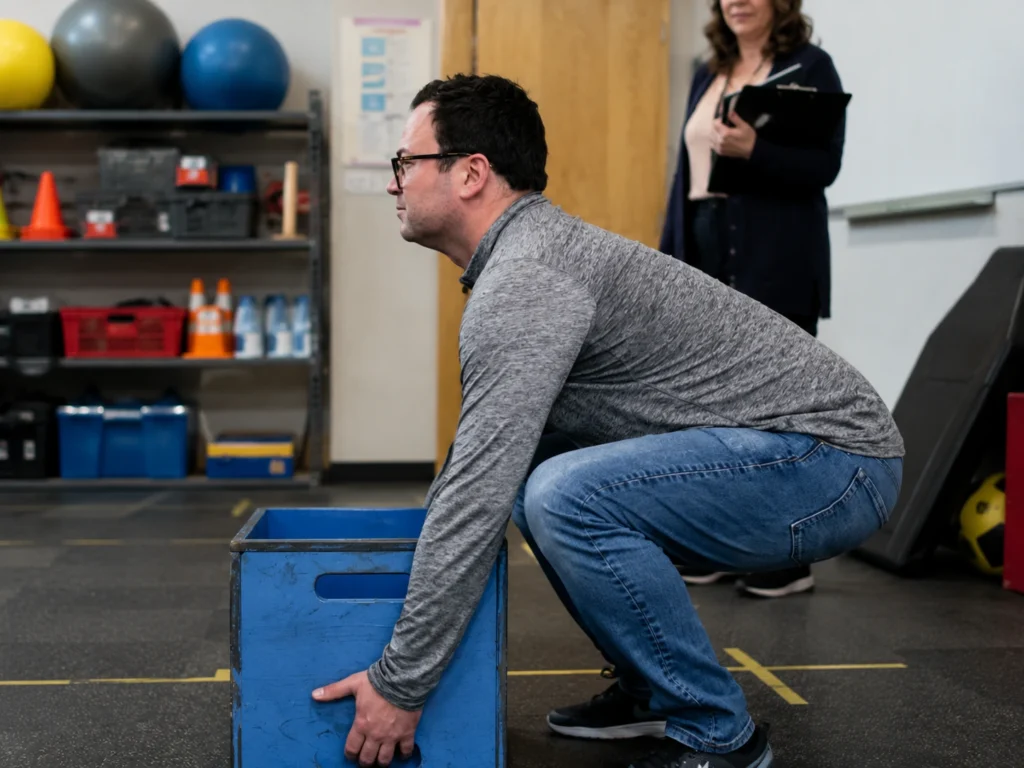
A physical ability test is a pre-employment assessment that determines whether a candidate can safely perform the physical demands of a specific job. It is important because it helps employers improve hiring accuracy, reduce workplace injuries, lower workers’ compensation exposure, and support workforce safety. Unlike general fitness testing, a physical ability test evaluates job-specific tasks such as lifting, carrying, pushing, pulling, and sustained physical exertion.
Physical Ability Testing (PAT) is a structured pre-employment assessment that evaluates a candidate’s ability to safely perform essential job tasks before hiring. Unlike interviews or general fitness checks, physical ability tests are directly tied to real job demands such as lifting, carrying, pushing, pulling, climbing, or sustained physical exertion.
It ensures job-person fit and reduces musculoskeletal injuries, early turnover, and workers’ compensation claims. This is also where a comprehensive job analysis helps align job demands with actual working conditions.
For the modern workforce, physical ability tests are not just a screening tool; it is a proactive risk-reduction mechanism that helps employers connect hiring decisions to workforce safety outcomes and operational performance.
However, not all physical abilities testing programs deliver the same outcomes. The effectiveness of a physical ability test depends on how accurately it reflects the job’s actual physical demands and identifies candidates who can meet them.
Assessments built around documented job requirements are more effective at evaluating job readiness than generic fitness-based testing because they measure the movements, exertion levels, and physical capabilities employees will be expected to perform on the job.
Why Most Physical Ability Test Programs Break at Scale?
Research shows that physical job performance relies on multiple factors, including strength, endurance, movement quality, and sustained task execution in real working conditions.
Most physical ability test programs fail at scale for three compounding reasons:
Equipment-dependent testing: Testing protocols that require equipment are built for single-site applications. Replicating them across 50, 100, or 200 locations requires duplicated equipment, infrastructure, dedicated space, and significant capital, making consistent rollout impractical for most enterprise operations.
Evaluator drift: Without centralized training, calibration, and scoring rubrics, different evaluators at different sites apply different scoring standards. Over time, this inconsistency erodes hiring accuracy, legal defensibility, and workforce safety outcomes across the enterprise.
Workflow bottlenecks: When physical ability tests create scheduling delays, candidate drop-off, and delayed test results, HR and operations teams cannot act on hiring decisions efficiently, and valuable candidates are lost in a tight labor market.
Decreased Defensibility. Without structured job analysis and confirmation of those analyses for every location, organizations struggle to connect testing to the real world, which in turn jeopardizes defensibility.
This guide explains how to scale physical abilities testing across multiple locations using minimal equipment, standardized execution, and zero disruption to hiring workflows, while maintaining safety and defensibility throughout.
How to Implement Physical Abilities Testing?
Implementing Physical Abilities Testing (PAT) starts with identifying the real physical demands of the job and translating them into standardized, job-specific assessments. When supported by structured job analysis and consistent test administration protocols, physical ability tests help improve effective employee selection, reduce workplace injuries, and strengthen workforce safety outcomes.
Key steps to implement Physical Abilities Testing:
- Conduct a structured job and physical demands analysis for each role
- Build task-based assessments that reflect actual workplace movements and conditions
- Standardize scoring criteria and testing procedures across all locations
- Administer PAT after a conditional job offer to maintain compliance and fairness
- Integrate test results into hiring, safety, and workforce management systems
- Continuously refine testing protocols using injury trends and operational data
How to Scale Hiring Across Multiple Locations?
How Do You Scale Physical Abilities Testing Across Multiple Locations Without Slowing Down Hiring?
Organizations can scale physical abilities testing without slowing down hiring by standardizing job requirements, using efficient testing protocols, and integrating assessments directly into hiring workflows. Consistent scoring criteria, centralized oversight, and automated scheduling and test results help reduce onboarding delays and candidate drop-off. This allows employers to maintain workforce safety standards while deploying physical abilities testing efficiently across multiple locations.
Scaling hiring across multiple locations requires standardized workflows, centralized oversight, and consistent job-demand validation across every site. Organizations that have an online platform, efficient protocols, and workflows to deliver timely results at scale promote effective, timely hiring that does not compromise time-to-fill position metrics.
Key strategies:
- Standardize hiring and PAT protocols across all locations
- Use cost-effective testing systems with minimal equipment demands
- Integrate PAT into hiring workflows
- Apply consistent scoring standards
- Automate scheduling, reporting, and candidate tracking

Step-by-Step Guide to Scaling Physical Abilities Testing Without Disruption
Step 1: Quantify the Job Demands Before You Standardize the Test
What it is
Most organizations struggle to scale Physical Abilities Testing because job expectations vary across sites and supervisors, leading to inconsistent hiring decisions and preventable injuries. Many organizations mistakenly view physical abilities testing as a generic fitness assessment rather than a structured job-specific testing system.
At its core, a physical abilities test is about evaluating candidates against clearly defined physical job requirements. Jobs may vary across locations due to differences in equipment, tools, construction, or the organization of the physical environment. Without location-specific job demands, each location may end up testing the wrong expectations, making consistent hiring and scalable testing difficult to achieve.
How to standardize hiring processes?
What to do
-
- Conduct on-site structured job analysis for each role (lifting, carrying, push/pull forces, endurance) at a significant and strategic sample of locations.
- Break tasks into measurable physical components (weight, frequency, duration)
- Validate job demands with supervisors and high-performing employees at each location
- Document outputs into a standardized job analysis report
- Share that report with locations that did not undergo the onsite analysis.
- Allow input, and any modification necessary for each location. Customize the test for each location as needed.
- If all job demands are the same across all locations, a simple sign-off process is all that is needed.
Why it matters
A job-specific baseline ensures that every candidate is evaluated against the physical requirements of their relevant location, thereby strengthening the legal defensibility of hiring decisions. If there is no variability across locations, the test will be the same at each location.
Step 2: Design Modular, Equipment-Light Testing Protocols
What it is
Many organizations struggle to scale a physical ability test program because traditional systems rely on heavy equipment, fixed facilities, and complex setups that can’t be replicated across locations. Scaling challenges often arise when organizations view PAT as an equipment-based testing process rather than a standardized job-demand testing system.
By using equipment-light functional tests, physical abilities testing programs can be deployed consistently anywhere, without specialized infrastructure. This is also where job demands analysis plays a key role, ensuring tests reflect real-world physical demands rather than artificial machine-based movements that don’t withstand legal scrutiny.
Physical ability tests can be deployed consistently across distributed operations without requiring expensive infrastructure duplication or equipment-heavy testing environments.
What to do
- Translate job tasks into simple functional movement tests (lift, carry, reach, push/pull)
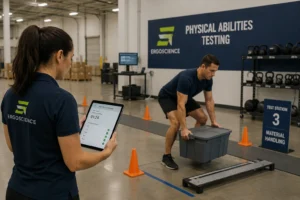
- Replace machines with calibrated, portable tools (weighted boxes, push-pull sleds, step ladders)
- Standardize test scoring criteria across all locations
- Eliminate non-essential equipment that does not directly map to job performance
- Design tests to be repeatable in small rooms, clinics, or onsite spaces
Why it matters
Reducing equipment dependency enables physical ability tests to scale across hundreds of locations without duplicating infrastructure. It also reduces setup costs while maintaining consistency and reliability across all test environments.
Step 3: Embed PAT Into the Hiring Workflow (Not After It)
What it is
A major scaling failure occurs when physical ability tests are treated as a separate step after hiring, and after valuable dollars have been wasted in onboarding and training. This step resolves that by embedding testing directly into the hiring workflow, so candidates move seamlessly from conditional offer to evaluation without interrupting speed or onboarding and training.
What to do
- Require the PAT immediately after a conditional offer has been made
- Use a testing partner that has an online scheduling platform and readily available nearby clinics
- Align recruiters on pass/fail decision criteria and steps for rescinding the offer or offering alternate placement if available
- Integrate test results directly into HR systems
Why it matters
When physical abilities testing is detached from hiring workflows, it becomes a bottleneck. Embedding PAT directly into recruitment and conditional offers eliminates onboarding delays, reduces candidate drop-off, improves hiring throughput, and prevents operational disruption caused by fragmented testing workflows.Integrated physical abilities testing workflows also help organizations reduce candidate drop-off, accelerate time-to-hire, and improve recruiter efficiency by eliminating fragmented scheduling and manual coordination between departments.

Step 4: Deploy a Multi-Site Standardization System
How Do You Make a Physical Ability Test Legally Defensible?
A physical ability test becomes legally defensible when it is based on documented job requirements, standardized scoring criteria, and consistent administration procedures. Employers should conduct formal job analyses and, if significant job variability exists across locations, all candidates must be evaluated against location-specific objective standards. If there is no variability across locations, the same test items and passing criteria can be used for all. Centralized training, quality controls, and documented testing protocols help demonstrate that hiring decisions are directly tied to the job’s actual physical demands.
What it is
Organizations operating across multiple locations often struggle with inconsistent testing practices, where different clinics and their evaluators apply different tests and standards. Variability often occurs when organizations treat physical ability tests as a loosely defined process instead of a standardized enterprise-wide system.
This step addresses that by centralizing PAT protocols, ensuring that every site administers tests consistent with that site, and that test protocols use consistent scoring rubrics, thereby reducing variability and strengthening legal and operational defensibility.
What to do
- Train test evaluators on standardized protocols
- Use unified scoring rubrics across all sites
- Conduct periodic calibration audits between locations
- Centralize reporting dashboards for visibility across the enterprise
- Establish quality control checks for test administration consistency
Why it matters
Without standardization, physical ability testing loses legal defensibility, operational consistency, and enterprise-wide reliability. ErgoScience addresses this challenge through job- and location-specific testing protocols built from detailed job analyses and supported by peer-reviewed occupational research, helping employers maintain appropriate consistency while incorporating location-specific nuances across every location.
Step 5: Digitize Reporting and Decision-Making
What it is
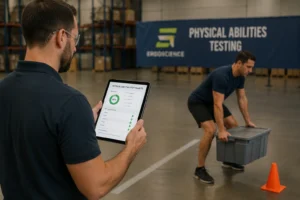
Many organizations still rely on manual scoring sheets and disconnected reporting systems, which slow down hiring decisions and create data gaps. This step eliminates that inefficiency by using an online testing platform that reduces delays in test results and by leveraging centralized systems that deliver instant, standardized hiring decisions and enable data-driven workforce planning.
What to do
- Utilize a testing partner with online testing to eliminate paper-based documentation
- Integrate results into centralized dashboards
- Automate pass/fail thresholds based on job requirements
- Provide real-time visibility to HR, training, and operations teams
- Use analytics to track injury correlation and hiring effectiveness
Why it matters
Online platforms reduce administrative burden and help organizations scale physical abilities testing across multiple hiring locations without sacrificing consistency.
Online PAT platforms also help reduce administrative processing time, improve reporting accuracy, and support faster workforce decision-making across multiple hiring locations.
Step 6: Deploy a Multi-Component Program
Can Physical Abilities Testing Reduce Workplace Injuries and Workers’ Compensation Costs?
Yes. Physical abilities testing can reduce workplace injuries and workers’ compensation costs by verifying that candidates can safely perform job-specific physical demands before placement. When grounded in a comprehensive job analysis and implmented as part of a broader MSD prevention program, testing helps improve job-person fit, reduce exposure to musculoskeletal injuries, and support safer workforce decisions. This can lead to fewer injury-related claims, lower costs, and improved operational continuity.
What it is
Most organizations treat PAT as a stand-alone program, meaning they realize only part of the value it can deliver at scale. PAT is most effective when it functions as part of a broader injury prevention system, not as a standalone hiring tool. This step ensures PAT outcomes remain connected to ongoing prevention efforts, such as ergonomic evaluation, modification, and training; early intervention; and return-to-work programs. Tracking the outcomes associated with PAT implementation is critical in determining the financial impact of the program.
What to do
- Link PAT results to injury data and MSD trends
- Feed insights into workforce safety programs
- Coordinate with ergonomic evaluation initiatives to identify job risk patterns
- Adjust job design or training based on recurring failure points
- Continuously refine testing based on injury outcomes
Why it matters
When integrated with broader injury prevention systems, PAT becomes a proactive workforce risk-reduction tool that helps reduce MSD exposure, improve hiring accuracy, and strengthen operational continuity across distributed operations.
Organizations that align PAT with ergonomic evaluation and injury prevention strategies are better positioned to reduce MSD-related disruptions, improve workforce retention, and strengthen long-term operational stability.
How To Reduce Workplace Injuries In Physical Jobs?
Here’s how ErgoScience helps organizations reduce workplace injuries while improving hiring accuracy, workforce safety, and operational consistency at scale:
- Job-Specific Physical Abilities Testing: Conducts structured PAT aligned to real workplace demands before hiring decisions are made.
- Ergonomic Evaluation and Risk Analysis: Identifies repetitive strain exposure, high-risk movements, and potential MSD risk factors across job tasks.
- Validated Job Demand Assessments: Measures lifting, carrying, pushing, pulling, and movement requirements using standardized job analysis methods.
- Multi-Site Standardization: Creates consistent (yet location-specific if needed) physical job expectations and testing protocols across all locations and workforce environments.
- Injury Trend Monitoring: Tracks workforce injury patterns and operational data to continuously improve safety outcomes and hiring accuracy.
- Integrated Injury Prevention Strategy: Connects physical abilities testing with broader workforce safety, ergonomic evaluation, and return-to-work programs.
Pro Tip: Common Mistakes in Scaling Physical Ability Tests (Dos & Don’ts)
| Do (What Works) | Don’t (What Breaks Scaling) |
| Standardize job requirements through structured onsite job analysis before designing any test. | Don’t design or roll out PAT based on job descriptions or manager assumptions. |
| Use simple, portable, job-based functional tests that can be replicated anywhere. | Don’t rely on heavy, fixed, site-specific equipment that limits scalability. |
| Embed PAT directly into the hiring workflow to maintain speed and reduce drop-offs. | Don’t conduct pre-offer or post-hire testing. |
| Use a testing protocol with standardized scoring rubrics so every test is scored consistently. | Don’t allow each site or assessor to interpret scoring independently. |
| Use a vendor with an online platform for instant results and integration with HR systems. | Don’t rely on a vendor who uses paper scoring sheets or disconnected spreadsheets. |
| Assess physical ability test outcomes with injury data and workforce safety insights. | Don’t run PAT without feedback loops from injury or MSD trends. |
| Partner with a testing provider that trains assessors consistently and audits performance across locations. | Don’t assume local teams will naturally administer tests the same way. |
| Continuously refine tests based on injury outcomes and operational data. | Don’t treat PAT as a one-time setup without ongoing optimization. |
Scale Physical Ability Tests with ErgoScience for Safer, Faster Hiring
Physical Abilities Testing programs often break down at scale because they are built for individual sites rather than enterprise-wide workforce operations. Most organizations struggle to scale PAT because they build programs around fixed equipment and decentralized execution rather than standardized workflows, centralized oversight, and scalable workforce infrastructure.
Modern workforce systems solve this by shifting PAT into a modular, digitally integrated framework that can operate consistently across multiple locations without slowing down hiring.
ErgoScience enables this shift through a methodology that most PAT providers cannot replicate. Every testing protocol is grounded in formal job analysis, validated against real-world physical demands, and backed by published research in peer-reviewed international occupational health journals, creating a level of scientific rigor and legal defensibility that goes beyond standard pre-hire screening.
The results are documented. Employers using ErgoScience-enabled PAT programs have reported up to a 78% reduction in workers’ compensation costs, driven by fewer MSD-related injuries, improved employee selection, reduced turnover, and lower operational disruption across multi-site workforces.
For organizations operating at scale, ErgoScience is not just a testing vendor. It is a workforce injury prevention partner that connects employee selection, ergonomic evaluation, and long-term safety outcomes into a single, continuously optimized system. Services can be chosen à la carte or as a complete package.
Ready to transform physical abilities testing into a competitive advantage for workforce safety and performance?
FAQs
1. Will a physical ability test slow down my hiring process?
No. Organizations that understand what a physical ability test is know it works best when integrated directly into the hiring workflow. Instead of creating delays, modern PAT systems help reduce onboarding bottlenecks, improve hiring throughput, and minimize operational disruption caused by inconsistent screening or injury-related turnover.
2. How can I scale physical abilities testing across multiple locations without expensive equipment?
Modern physical abilities testing programs rely on portable, job-specific testing instead of heavy fixed equipment or centralized facilities. Combined with standardized workflows, organizations can scale hiring across multiple locations while controlling infrastructure costs and maintaining consistent workforce safety standards.
3. How can a physical ability test help me reduce workplace injuries and workers’ compensation costs?
A physical ability test validates whether candidates can safely perform real job demands before hiring and placement, helping reduce musculoskeletal injuries, workers’ compensation exposure, overtime costs, and operational downtime. When paired with ergonomic evaluation and early intervention, physical abilities testing also improves long-term injury prevention and workforce stability.
4. How can I ensure a physical ability test remains legally defensible across multiple locations?
A physical ability test is most defensible when grounded in formal job analysis, standardized scoring criteria, and consistent administration procedures across all locations, ensuring every hiring decision is directly tied to documented physical job requirements. ErgoScience adds a second layer of defensibility that most providers cannot offer: published, peer-reviewed research validating the reliability and accuracy of its testing protocols and scoring systems. It is one thing to claim a test reflects the job; it is another to prove the test is accurate through independently published research.
Faster, Safer, and More Scalable Hiring Outcomes with ErgoScience-Enabled PAT
When organizations first ask “What is PAT?”, it is often viewed as a hiring compliance step. With ErgoScience, physical abilities testing becomes a scalable workforce performance system that improves hiring speed, consistency, and workforce safety across multiple locations.
Key Business Outcomes
- Faster hiring throughput by reducing testing bottlenecks and onboarding delays
- Lower workplace injury rates through job-specific testing
- Reduced workers’ compensation, overtime, and backfill costs
- Standardized, legally defensible hiring decisions across all locations
- Lower infrastructure costs with portable, low-equipment PAT systems
- Improved workforce retention through better job-person fit
- Real-time visibility through integrated reporting and ATS connectivity
- Stronger long-term injury prevention through continuous ergonomic evaluation and workforce safety insights