Improve Your Experience Modification Rate and Lower Workers’ Compensation Costs Through Proactive Injury Prevention

ErgoScience combines research-backed physical ability testing with ergonomic assessments and early intervention to reduce workplace injuries and improve the factors that influence your experience modification rate.
Legally Defensible Testing
Measurable Injury Reduction and ROI


Proud Partnerships

Brands that Trust ErgoScience

Partner Logo 1
Partner Logo 2
Partner Logo 3
Partner Logo 4
Partner Logo 5
Partner Logo 6
Alabama Power
Buffalo Rock
Greenbush
Hartford
HS Express
Leadec
Lineage
McElroy
Mitchell
Pritchett
Royal
Yes
Partner Logo 1
Partner Logo 2
Partner Logo 3
Partner Logo 4
Partner Logo 5
Partner Logo 6
Alabama Power
Buffalo Rock
Greenbush
Hartford
HS Express
Leadec
Lineage
McElroy
Mitchell
Pritchett
Royal
Yes
Safety Director Heavy Industry Manufacturing
Quote mark

In researching companies to help us implement a pre-employment physical testing program, we wanted to find a program that would give us the peace of mind that any candidate we hired would be physically able to do the job and that the process itself would be fair and defensible. The methods used by ErgoScience met these objectives.

Gary Cameron, HR Director | Mitchell Grocery Corp

What Is Experience Modification Rate (EMR)?

Experience Modification Rate (EMR) is a numerical rating used by workers’ compensation insurers to compare an employer’s claims history with the expected claims experience of similar businesses in the same industry. Also known as the Experience Modification Factor (E-Mod or Mod Rate), it helps determine whether a company has experienced more or fewer workplace injuries than expected.
An EMR of 1.00 represents the industry average.
  • Below 1.00: Better-than-average claims experience
  • Above 1.00: Higher-than-average claims experience
A lower Experience Modification Rate (EMR) generally reflects fewer and less severe workers’ compensation claims, while a higher EMR indicates more frequent or more costly claims. 

How Does a High Experience Modification Rate Affect Your Costs and Business Opportunities?

A high Experience Modification Rate can increase workers’ compensation premiums and affect eligibility for certain business opportunities. Without proactive injury prevention, poor loss performance can continue to pressure operating budgets and limit business growth.
Increase Workers’ Compensation Premiums
A higher EMR can increase workers’ compensation insurance costs and place additional pressure on operating budgets.
Limit Contract Opportunities
Some clients and project owners consider EMR during contractor or vendor prequalification, potentially affecting eligibility for certain business opportunities.
Disrupt Workforce Productivity
The workplace injuries and claims associated with poor loss experience can increase absenteeism, overtime, temporary staffing needs, and operational delays.
Increase Workers’ Compensation Premiums
Frequent injuries require Safety, HR, Risk, and Workers’ Compensation teams to spend more time on investigations, documentation, claims coordination, and return-to-work processes.
Affect Your Safety Reputation
A higher EMR may negatively influence how customers, partners, and other stakeholders perceive your organization’s historical workers’ compensation and loss performance.
Build a proactive workplace injury prevention strategy that supports long-term safety performance.

13

PAT Outcome Studies

78,000

PATs

78%

Average Decrease in WC Costs

11.1

Average Return on Investment

What Drives Your Experience Modification Rate (EMR)?

Experience Modification Rate (EMR) is a numerical rating used by workers’ compensation insurers to compare an employer’s claims history with the expected claims experience of similar businesses in the same industry. Also known as the Experience Modification Factor (E-Mod or Mod Rate), it helps determine whether a company has experienced more or fewer workplace injuries than expected.
  • Injury Frequency: The number of workers’ compensation claims filed.
  • Injury Severity: The overall cost and seriousness of workplace injuries.
  • Lost-Time Claims: Claims involving extended employee absences typically have a greater financial impact.
  • Musculoskeletal Disorders (MSDs): Repetitive strain injuries often generate costly medical treatment and prolonged recovery periods.
  • Return-to-Work Effectiveness: Delayed or unsuccessful return-to-work programs may increase claim costs.
  • Historical Claims Experience: EMR is based on multiple years of workers’ compensation claims history rather than recent incidents alone.

Hear How Employers Reduced Workplace Injuries

We found the ErgoScience pre-hire testing implementation to be remarkably smooth. My experience as a beta tester was excellent – the scheduling was easy, and the clinicians were both knowledgeable and genuinely helpful.

Mario Castenada

Talent Acquisition
ErgoScience’s computer-vision ergonomic assessments have helped us identify and quantify ergonomic risks that impact our associates. Their recommendations have helped us make practical, cost-effective changes to prevent further injury.

Safety Director

Heavy Industry Manufacturing

How Can Workplace Injury Prevention Help Lower Your Experience Modification Rate (EMR)?

Proactive workplace injury prevention can help reduce workplace injuries and associated workers’ compensation costs, supporting a healthier Experience Modification Rate over time.

Research-Backed Methodology: Built on validated occupational research and detailed job analysis.

Integrated Workplace Injury Prevention: Combines Physical Ability Testing, ergonomics, early intervention, and Fitness-for-Duty Testing.

Legally Defensible Evaluations: Objective, job-related assessments designed to support compliant hiring decisions.

Enterprise-Scale Delivery: Consistent implementation across multi-site and distributed workforces.

Continuous Improvement: Uses injury trends and program outcomes to optimize long-term performance.


Turn workplace injury prevention into measurable business results.

What Is a Good Experience Modification Rate (EMR)?

A good Experience Modification Rate (EMR) is generally below 1.00, meaning an employer has experienced fewer or less costly workers’ compensation claims than expected for its industry. The lower the EMR, the stronger an organization’s historical claims performance.
Experience Modification Rate (EMR) What It Typically Means
Below 0.80 Excellent claims history and strong safety performance
0.80–0.99 Better-than-average workers' compensation experience
1.00 Industry average
1.01–1.24 Higher-than-average claims experience
1.25 and above Significantly higher claims costs may increase insurance premiums and affect contract eligibility

How a Trucking Company Reduced Injury Costs by 54% With Job-Specific Physical Ability Tests

Discover how a research-backed physical ability test helped Tim improve hiring accuracy and dramatically reduce injury costs.

Why Choose ErgoScience to Strengthen Workplace Injury Prevention and Support a Healthier EMR?

Generic safety programs may overlook the job-specific physical demands and ergonomic risks contributing to workplace injuries. ErgoScience combines research-backed methods, customized solutions, and measurable program optimization to help large, physically demanding workforces reduce injury risk and improve the factors that influence Experience Modification Rate over time.

Research-Backed Methodology: Grounded in peer-reviewed occupational research and validated testing methods.

Role-Specific Physical Ability Testing: Evaluate candidates against the actual physical demands of each job using customized testing protocols.

Legally Defensible Testing: Support objective, job-related employment decisions through detailed job analyses, validated testing protocols, and research-backed scoring systems.

Complete Workplace Injury Prevention Platform: Address injury risk across the employee lifecycle through Physical Ability Testing, ergonomic assessments, training, early intervention, and Fitness-for-Duty Testing.

Enterprise-Scale Delivery: Deploy consistent testing programs across 100+ locations without duplicating heavy equipment or infrastructure.

Measurable Injury Reduction and ROI: Evaluate injury outcomes, validate program ROI, and continuously optimize workplace injury prevention programs.

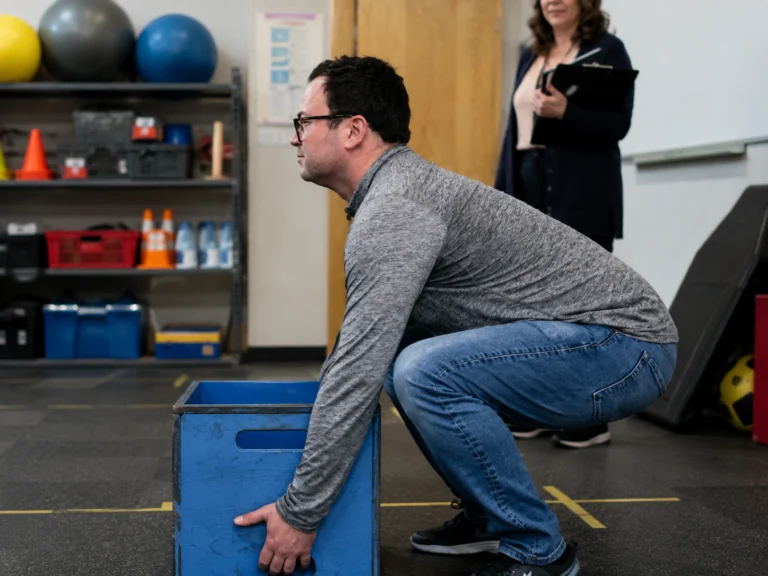
Build a scalable, research-backed workplace injury prevention program that delivers measurable business results.

Real-World Results From an ErgoScience Client

Case Study:

Beverage Distribution

Mid-Sized bottling company saves $4,000,000 over 4 years with Pre-Hire Employee Testing Our client manufactures and sells almost a billion containers of product annually. Employees work at multiple distribution centers and the delivery fleet consists of approximately 1,800 vehicles.

How ErgoScience Helps Reduce the Factors That Influence Experience Modification Rate (EMR)

Rather than managing claims after injuries occur, ErgoScience helps reduce workplace risks that affect the Experience Modification Rate (EMR) through proactive injury prevention.

Analyze the Job

ErgoScience begins by evaluating job demands, physical requirements, and workplace risk factors through detailed job analyses.

Hire the Right Candidates

Based on the findings, ErgoScience develops a workplace injury prevention strategy using the right combination of Physical Ability Testing, ergonomic assessments, and other preventive services.

Reduce Ergonomic Risk

Identify and address ergonomic hazards that increase MSD risk.

Train Employees

Promote safer movement, lifting, and work practices.

Intervene Early

Address discomfort before it becomes a recordable injury.

Support Safe Return-to-Work

Use Fitness-for-Duty Testing to reduce reinjury risk.

Continuously Improve

Track injury trends and optimize safety programs over time.
See how a proactive injury prevention program fits your workforce.

Support a Healthier Experience Modification Rate Through Proactive Workplace Injury Prevention

Reducing workplace injury risks can help improve workers’ compensation outcomes and support a healthier Experience Modification Rate over time. ErgoScience combines research-backed testing, ergonomics, early intervention, and continuous program optimization to build safer, more resilient workforces.
Key takeaways:
  • Understand how workers’ compensation claims can influence your Experience Modification Rate.
  • Identify workplace injury risks contributing to higher claim costs.
  • Improve physical job fit through job-specific Physical Ability Testing.
  • Reduce ergonomic and musculoskeletal disorder (MSD) risks across the employee lifecycle.
  • Measure injury outcomes and continuously optimize workplace injury prevention.
Build a safer workforce while improving the injury and claims outcomes that influence your Experience Modification Rate.

Frequently Asked Questions

Yes. While the Experience Modification Rate (EMR) is calculated by workers' compensation rating organizations, employers can improve the factors that influence it by reducing workplace injuries and workers' compensation claims. A proactive workplace injury prevention strategy designed to reduce injury risk and associated workers’ compensation claims can support a healthier EMR over time.
Experience Modification Rate (EMR) is based on several years of workers' compensation claims history rather than a single year's performance. As a result, improvements typically occur gradually as organizations consistently reduce workplace injuries, control claim costs, and strengthen workplace injury prevention efforts.
The biggest drivers of Experience Modification Rate (EMR) are the frequency, severity, and cost of workers' compensation claims. Frequent workplace injuries, lost-time incidents, and high-cost claims generally have the greatest impact. Reducing these through effective workplace injury prevention can improve the underlying factors that influence EMR.
Yes. Effective workplace injury prevention helps reduce the frequency and severity of workplace injuries, leading to fewer workers' compensation claims and lower claim costs. While no program directly controls Experience Modification Rate (EMR), reducing the workplace risks that drive claims can positively influence EMR over time.

Additional Resources to Strengthen Workplace Injury Prevention

5 Reasons New Hires Get Injured in Physically Demanding Jobs and How Workplace Injury Prevention Can Help

Reduce workforce injuries, improve hiring accuracy, and lower MSD risk with proactive workplace injury prevention strategies…

Physical Ability Testing Explained: How to Improve Hiring Accuracy, Reduce Injuries, and Scale Workforce Assessments

A step-by-step operational guide to scaling physical ability tests without workflow disruption or heavy infrastructure…

Turn workplace injury prevention into lower claim costs, safer operations, and a stronger Experience Modification Rate (EMR).