

An employee may be medically cleared to return to work, but are they physically ready to perform their job safely?
For example, HR may have a medical release while Operations still needs to confirm whether a lifting restriction can be accommodated on the assigned shift.
The scale of workplace injuries makes getting these decisions right important. According to the U.S. Bureau of Labor Statistics, private industry employers reported 2.5 million nonfatal workplace injuries and illnesses in 2024.
Across 2023–2024, overexertion, repetitive motion, and bodily conditions accounted for 946,290 cases involving days away from work, restricted work activity, or job transfer.
For employers with physically demanding jobs, standardizing return-to-work decisions requires more than a medical release. Safety, Risk, and HR need a shared process built around documented job demands, functional readiness, consistent evaluation criteria, and clear communication. Job-specific fitness-for-duty testing can help determine whether an employee is ready to resume essential job functions or may need modified duties or work conditioning.
In this guide, we’ll explore seven practical steps to standardize return-to-work decisions across departments, improve coordination, and support safer, more consistent employee transitions back to work.
- Define the Physical Demands of Each Job
- Establish Shared Return-to-Work Criteria
- Evaluate Functional Readiness Beyond Medical Clearance
- Use Consistent, Job-Specific Fitness-for-Duty Testing
- Establish a Process for Modified Duty and Work Conditioning
- Standardize Documentation and Communication Across Departments
- Track Outcomes and Continuously Improve the Return-to-Work Program
What Does a Standardized Return-to-Work Process Involve?
A standardized return-to-work program establishes a consistent, documented process for determining when an injured employee can safely resume their job duties. It aligns Safety, Risk, and HR around shared criteria, clear responsibilities, and objective evidence rather than relying on individual judgment or medical clearance alone.
An effective process starts with understanding the physical demands of each role and comparing them with the employee’s functional abilities and applicable work restrictions. When necessary, fitness-for-duty testing helps assess whether an employee can perform essential job functions safely or requires modified duties or work conditioning before returning to full duty.
For employers managing large, physically demanding workforces across multiple locations, a consistent return-to-work process also creates a common approach to documentation, communication, and outcome tracking. It helps teams coordinate decisions, manage workers’ compensation responsibilities, and identify opportunities for workplace injury prevention.
The goal is not simply to get employees back to work quickly. It is to support safe, sustainable returns through job-specific assessments, consistent decision-making, and ongoing evaluation.
7 Steps to Standardize Return-to-Work Decisions Across Safety, Risk, and HR
A consistent return-to-work program requires more than medical clearance. Employers need a structured process that connects job requirements, functional readiness, fitness-for-duty testing, and clear communication across departments. These seven steps help Safety, Risk, and HR make better-informed decisions, manage work restrictions, and support workplace injury prevention across physically demanding roles.
Step 1: Define the Physical Demands of Each Job

What it is
Job analysis identifies the actual physical requirements of a role, including lifting, carrying, pushing, pulling, repetitive movements, and endurance. These documented requirements provide a baseline for evaluating whether an employee can safely resume their essential job functions.
How to implement
- Observe employees performing their regular job tasks.
- Document essential functions, physical demands, movement patterns, and environmental conditions.
- Identify tasks that place significant physical demands on employees.
- Maintain job-specific requirements for use during return-to-work evaluations.
Why it matters
Documented job demands give Safety, Risk, and HR a shared reference for return-to-work decisions. They also provide the foundation for job-specific fitness-for-duty testing, helping employers assess readiness against actual work requirements rather than assumptions.
Step 2: Establish Shared Return-to-Work Criteria
What it is
Shared return-to-work criteria establish consistent guidelines for evaluating readiness, managing work restrictions, and determining appropriate next steps. They clarify how Safety, Risk, and HR contribute to decisions while maintaining their respective responsibilities.
How to implement
- Define job-related criteria for returning to full or modified duties.
- Assign responsibilities for reviewing restrictions, coordinating evaluations, and implementing work arrangements.
- Document who reviews medical restrictions, who coordinates job-specific assessment, who approves available work assignments, and who communicates the agreed plan. Clinical fitness determinations remain with qualified professionals.
- Establish a consistent process for documenting decisions and recommendations.
- Apply the same standards to comparable roles across locations, accounting for differences in job demands.
Why it matters
Shared criteria reduce conflicting interpretations of employee readiness and help departments coordinate their decisions. A documented process also improves accountability and supports consistent handling of return-to-work cases across teams and locations.
Who is responsible for approving an employee’s return to work: HR, Safety, or Risk Management?
HR, Safety, and Risk Management share responsibilities in the return-to-work process, but each has a distinct role. HR coordinates employee communication and work arrangements, Safety helps evaluate job demands and workplace risks, and Risk Management oversees relevant claims and risk considerations. These teams should coordinate with qualified healthcare professionals and Operations to ensure return-to-work decisions reflect medical restrictions, functional readiness, and available work assignments.
Step 3: Evaluate Functional Readiness Beyond Medical Clearance
What it is
Medical clearance addresses an employee’s medical status, but it may not establish whether they can perform every physical requirement of their job. Functional readiness considers the relationship between their capabilities, work restrictions, and essential job functions.
How to implement
- Review the employee’s medical release and applicable work restrictions.
- Compare restrictions with the documented physical demands of the job.
- Identify essential tasks that may require further functional evaluation.
- Seek job-specific fitness-for-duty testing when appropriate.
- Coordinate any additional assessment with the relevant healthcare and occupational professionals.
Why it matters
Evaluating functional readiness helps employers make more informed return-to-work decisions. It can identify mismatches between an employee’s current capabilities and job demands, supporting appropriate work modifications and helping reduce the risk of reinjury.
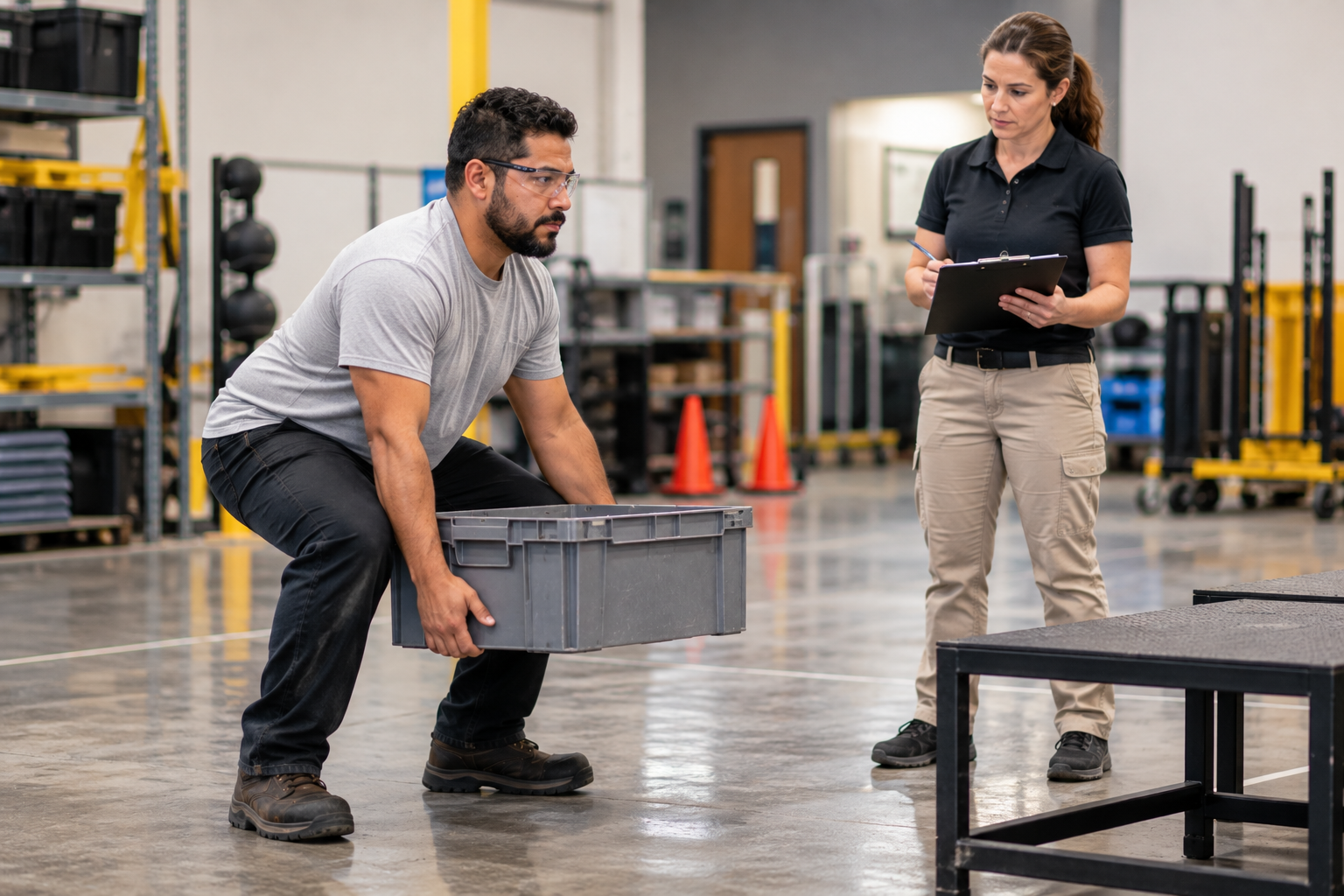
Illustrative example: A warehouse associate’s temporary lifting restriction is compared with documented case-picking demands. The team identifies tasks within the restriction and seeks appropriate professional assessment before considering full-duty work.
Step 4: Use Consistent, Job-Specific Fitness-for-Duty Testing
What it is
Return-to-work fitness-for-duty testing evaluates whether an employee can meet the physical demands of their particular role following an injury or illness. Tests should reflect relevant job tasks and assess capabilities associated with the employee’s work requirements and restrictions.
How to implement
- Identify essential physical tasks relevant to the job and the employee’s injury.
- Develop testing protocols based on documented job demands.
- Apply consistent procedures and objective performance criteria.
- Document findings and share relevant recommendations with authorized decision-makers.
- Use the results alongside medical guidance and applicable restrictions.
Why it matters
Job-specific fitness-for-duty testing gives employers objective information about functional readiness. It helps Safety, Risk, and HR make better-informed decisions about full duty, modified work, or further evaluation rather than relying solely on generalized fitness standards.
Step 5: Establish a Process for Modified Duty and Work Conditioning
What it is
Modified duty allows employees to perform suitable work within their current capabilities and restrictions. Work conditioning can help employees build the physical capacity needed for their jobs before resuming full duties, when appropriate.
How to implement
- Identify temporary assignments that align with documented capabilities and restrictions.
- Coordinate with HR and Operations to determine whether suitable modified work is available.
- Establish clear expectations for temporary duties and work limitations.
- Consider work conditioning when additional physical preparation is needed.
- Reassess readiness before returning to unrestricted duties.
Why it matters
A structured transition can help employees resume productive work without exceeding their current capabilities. Appropriate modified duties and work conditioning also give employers a practical way to support recovery while managing operational disruption.
Step 6: Standardize Documentation and Communication Across Departments
What it is
A standardized documentation process ensures that relevant return-to-work information is recorded consistently and communicated to authorized stakeholders. It connects evaluation findings, work restrictions, recommendations, and implementation decisions across Safety, Risk, and HR.
How to implement
- Record relevant job demands, work restrictions, evaluation findings, and recommendations.
- Document decisions about full duty, modified work, or further assessment.
- Assign responsibility for communicating approved work arrangements.
- Establish a consistent process for recording changes in work status.
- Protect confidential medical information and restrict access appropriately.
Why it matters
Consistent documentation helps departments understand the rationale behind return-to-work decisions and implement restrictions correctly. It also supports accountability, improves coordination, and provides records that may be needed for workers’ compensation and compliance processes.
What should a return-to-work checklist include?
A return-to-work checklist should include the employee’s medical release and applicable work restrictions, documented job demands, functional assessment findings, modified-duty requirements, assigned responsibilities, and follow-up arrangements. It should also identify who is responsible for reviewing restrictions, communicating approved work arrangements, documenting decisions, and monitoring the employee’s transition to regular duties.

Step 7: Track Outcomes and Continuously Improve the Return-to-Work Program
What it is
Ongoing program evaluation examines whether return-to-work procedures are supporting safe transitions, reducing avoidable disruption, and identifying opportunities for improvement. Employers can use injury data, workforce outcomes, and operational feedback to refine their processes.
How to implement
- Track reinjuries following employees’ return to work.
- Monitor time away from work and transitions from modified to full duty.
- Review workers’ compensation claims and recurring injury patterns.
- Identify roles, tasks, or locations associated with repeated problems.
- Use findings to improve job analyses, testing protocols, and work modifications.
Compare these measures against a pre-implementation baseline for comparable jobs or sites, accounting for changes in case mix and job demands.
Why it matters
Tracking outcomes helps employers identify gaps that individual return-to-work decisions may not reveal. Regular reviews support continuous improvement, strengthen workplace injury prevention efforts, and help organizations assess whether their programs are delivering measurable operational benefits.
How can employers measure the effectiveness of a return-to-work program?
Employers can measure return-to-work program effectiveness by tracking reinjury rates, days away from work, time taken to transition from modified to full duty, and workers’ compensation claims. Reviewing these metrics against pre-implementation baselines helps Safety, Risk, and HR identify recurring problems, evaluate program outcomes, and determine where improvements are needed.
How ErgoScience Helps Standardize Return-to-Work Decisions
Employers often struggle with return-to-work decisions because job requirements are unclear, departments follow different criteria, and medical clearance may not confirm job readiness.
ErgoScience combines job analysis, fitness-for-duty testing, and work conditioning to help employers make consistent, job-specific decisions, reduce reinjury risk, and strengthen workplace injury prevention.
Documented job demands provide the basis for selecting relevant physical tests and interpreting results against essential job requirements. This helps employers connect assessment findings with decisions about full duties, modified work, or further evaluation.
| Step | How ErgoScience Helps |
| 1. Define the Physical Demands of Each Job | Conducts job analysis to document essential job functions and physical requirements for return-to-work evaluations. |
| 2. Establish Shared Return-to-Work Criteria | Provides documented job requirements and objective testing findings to help Safety, Risk, and HR apply consistent, job-related criteria. |
| 3. Evaluate Functional Readiness Beyond Medical Clearance | Uses fitness-for-duty testing to assess whether employees can meet the physical demands relevant to their job and injury. |
| 4. Use Consistent, Job-Specific Fitness-for-Duty Testing | Develops customized tests based on actual job demands rather than generic fitness standards. |
| 5. Establish a Process for Modified Duty and Work Conditioning | Supports employees who are not ready for full duties through work conditioning and provides job-related insights to help employers evaluate appropriate modified-work arrangements. |
| 6. Standardize Documentation and Communication Across Departments | Provides documented job requirements and objective testing findings that employers can use to support consistent return-to-work decisions and internal coordination. |
| 7. Track Outcomes and Continuously Improve the Return-to-Work Program | Helps employers review injury and MSD trends, evaluate program outcomes and ROI using relevant performance data, and identify opportunities to refine injury prevention strategies. |
ErgoScience combines job analysis, return-to-work testing, and fitness-for-duty evaluations to help employers make better-informed decisions about when employees can resume full duties or may need modified work.
By integrating these services into a consistent return-to-work program, organizations can strengthen coordination across Safety, Risk, and HR while supporting safer, more sustainable returns to work.
Summary At a Glance
- A standardized return-to-work program helps Safety, Risk, and HR make consistent, job-specific decisions.
- Job analysis establishes the physical requirements employees must meet to perform their roles.
- Fitness-for-duty testing helps assess functional readiness beyond medical clearance alone.
- Modified duties and work conditioning can support employees who are not ready for full duties.
- Consistent documentation improves coordination and accountability across departments.
- Tracking injury trends and program outcomes helps employers improve workplace injury prevention.
- ErgoScience combines job analysis, fitness-for-duty testing, and work conditioning to support safer, more consistent returns to work.

Standardize Decisions With Job-Specific Criteria and Objective Evaluation
Inconsistent return-to-work decisions can increase reinjury risk, prolong absences, and raise workers’ compensation costs. Without clear job requirements and shared evaluation criteria, Safety, Risk, and HR may struggle to determine when employees are ready to resume their duties.
ErgoScience helps employers strengthen their return-to-work program through job analysis, job-specific fitness-for-duty testing, and work conditioning. These services help employers evaluate whether employees can meet their roles’ physical demands, identify when additional physical preparation may be needed, and make better-informed decisions about modified-work arrangements.
By combining objective job-related assessments with evidence-based interventions, ErgoScience helps employers support safer, more consistent returns to work across their workforce.
Make return-to-work decisions more consistent with ErgoScience.
Review job-demand documentation, decision criteria, and modified-duty coordination to identify opportunities to strengthen your return-to-work process.
Frequently Asked Questions
1. How can we standardize return-to-work decisions across Safety, Risk, and HR?
Employers can standardize return-to-work decisions by documenting job requirements, establishing shared evaluation criteria, assigning clear responsibilities, and maintaining consistent records. A structured return-to-work program helps departments coordinate decisions and assess employee readiness consistently.
2. How can we use fitness-for-duty testing to determine return-to-work readiness?
Fitness-for-duty testing evaluates whether an employee can meet the physical demands of their specific job following an injury or illness. ErgoScience uses job-specific testing to support decisions about returning to full duties, modified work, or further physical conditioning.
3. How can we reduce reinjury risk during the return-to-work process?
Employers can reduce reinjury risk by comparing an employee’s functional abilities with actual job demands, following applicable work restrictions, and considering modified duties or work conditioning when needed. Job-specific fitness-for-duty testing can help assess readiness before an employee resumes full responsibilities.
Build a Safer Return-to-Work Program and Reduce Reinjury Risk
ErgoScience helps employers verify job readiness, address ergonomic hazards, and support safer returns to work through job-specific testing and injury-prevention services.
Key Takeaways
- Verify readiness: Use job-specific fitness-for-duty testing.
- Support recovery: Provide modified duties and work conditioning.
- Reduce ergonomic risks: Identify and correct workplace hazards.
- Intervene early: Address symptoms before they worsen.
- Improve coordination: Align job demands, restrictions, and return-to-work decisions.
Identify opportunities to improve job-readiness assessments, work restrictions, ergonomic risk controls, and return-to-work coordination.
Strengthen Your Return-to-Work Program