
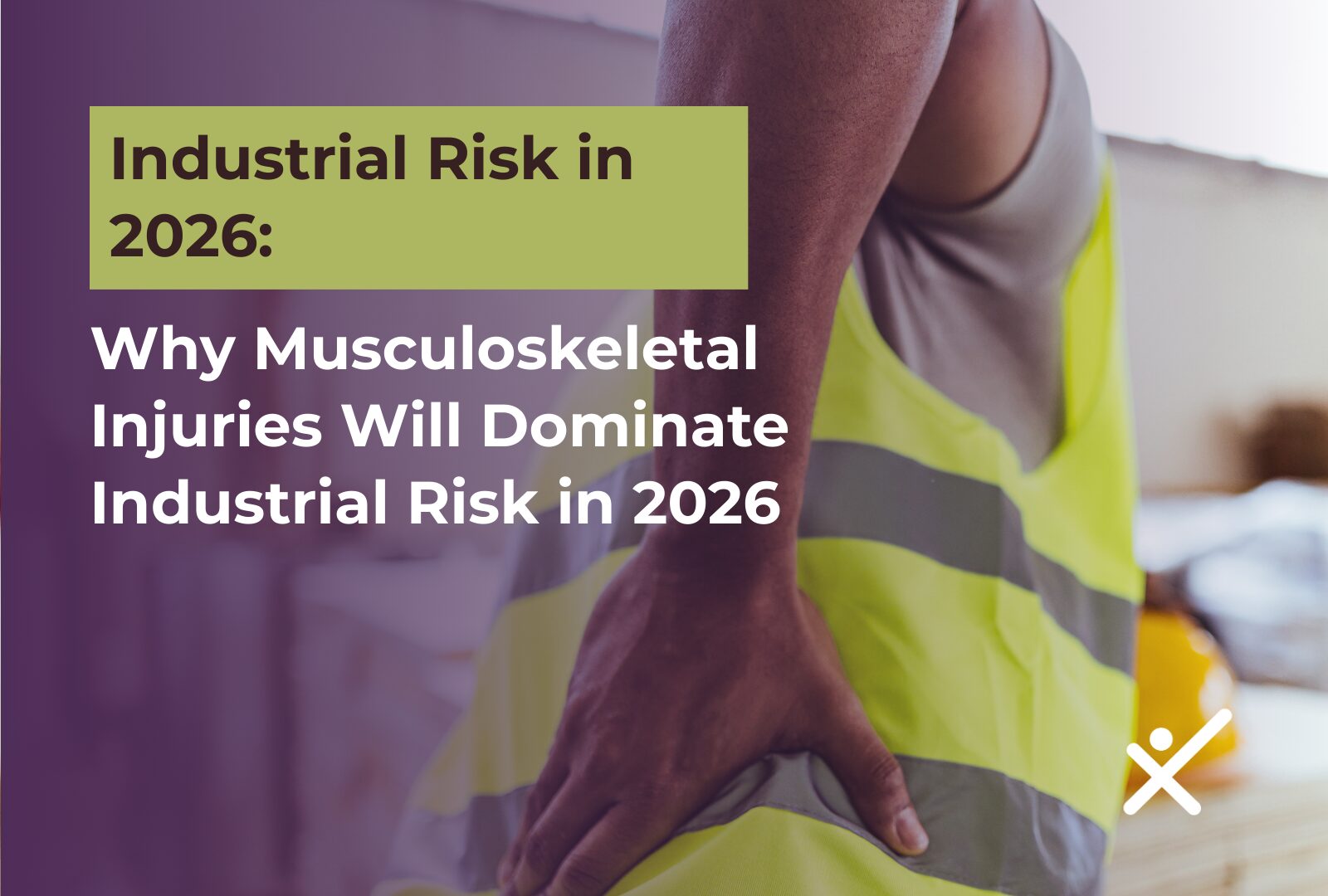
While risk management leaders guard their organizations against catastrophic events or cyberthreats, industrial musculoskeletal disorders (MSDs) are steadily eroding the bottom line. These injuries drain reserves, drive claim volatility, and compromise workforce stability—and most are fully preventable. Protect your profitability and secure favorable renewals by prioritizing predictive safety and integrated risk management.
Risk Management VPs must move beyond managing injuries to managing human performance and safety. Take a 360-degree approach to risk management to put your organization on a stronger footing. By integrating data-driven prevention with daily operations, you can stop MSDs before they impact your ledger or recordables.
As manual labor continues to be physically taxing and demands increase, industrial MSDs are taking a toll—physically and financially. These strains, sprains, and repetition-based injuries dominate loss runs and are projected to continue to account for 30-40 percent of workers’ compensation costs.
MSDs are still the least-controlled risk in the industrial space—not just driving injury but also longer claim durations, higher medical costs, and repeat claims. MSD claims can have a trickle-down effect that may as well be a waterfall:
This is a heavy weight to bear, and many organizations struggle to keep up. Here’s why:
For workers, industrial MSDs manifest physically, but the associated risks are so much greater. Research suggests that psychosocial hazards, such as stress, high demand, and low control, can accelerate MSD claims.
Think about who makes up your workforce. Do you have a crew of tenured pros? That time and expertise are immeasurable, but as age increases, so does vulnerability—and "wear and tear" claims could spike in severity.
Integrate not only workplace training but also a prevention strategy to control industrial musculoskeletal disorders. By doing so, your organization will be better positioned to reduce:
Food for thought: Prehire physical abilities testing decreases injuries by 78 percent, offering an 11-to-1 ROI. It’s just one piece to incorporate into your MSD prevention approach, and combined with additional best practices, can point you in a new direction.
A glowing history of positive loss runs is no guarantee you will secure the best terms. Insurance conversations are changing as carriers require proof that industrial organizations maintain ongoing MSD prevention. Go the extra mile to prove that your risk controls are active and scalable. For example, you can improve workers' compensation terms with technological prevention (wearables, AI analysis, digital screens).
Demonstrate your commitment to workplace safety and reduce industrial musculoskeletal disorders risks by proving your steadfast commitment to prevention.
As a risk management leader, do these questions ring a bell?
“What are you doing to reduce future MSD exposure?”
“How are you managing soft-tissue injury risk?”
You need to be able to answer carriers regarding both compliance and safety. And when a claim happens, confidently show your organization’s responsibility, such as whether an employee was fit for duty and the accuracy of the job description.
Make the shift toward integrated injury management to check all the boxes. Carriers reward employers who connect on-site prevention with claims management.
Integrated MSD prevention initiatives create a standard for risk management across the entire operation. By enacting a comprehensive program, you can take on a low capital investment with high loss impact and illustrate your commitment to proactive risk control and a standardized, enterprise-wide approach.
ErgoScience can help! Our university-validated research provides the objective data carriers trust during renewals and innovative solutions you can trust to amplify your risk management. Just one example? WorkReady Early Intervention, an OSHA-compliant first-aid strategy to resolve worker discomfort—and ultimately reduce your recordables.
Risk leaders are under pressure to reduce claim volatility, improve forecasting, and limit injuries. Protect your labor force and your organization by getting ahead of risks.
Industrial musculoskeletal disorders and related claims are unpredictable because they are cumulative. One day, it’s a little muscle twinge that builds slowly until it suddenly becomes too much to handle. Predictability means controlling risk management and return-to-work processes as tightly as hiring, and prioritizing predictive safety and continuous improvement can help.
To ensure predictability, risk managers are pivoting away from total recordable incident rate and days away, restricted, or transferred rates in favor of leading indicators. Refresh your approach and focus your attention on:
By taking action now, your organization could significantly improve its risk management position. Reduce the severity of industrial musculoskeletal disorders at first report, both physically by zapping downstream medical complexity and legally by mitigating litigation risks.
Here are just a few things you can integrate into your processes to create a culture of safety and stabilize year-over-year injury patterns:
Don’t wait for the first report of injury to trigger risk management processes. Industrial organizations are moving their defense upstream to the point of hiring and daily operations. Rethink your strategy, looping in key function areas to ensure physical capability before injuries or claims occur.
Work cross-functionally among safety, HR, and operations departments to develop controls that influence daily human performance and physical safety. Physical readiness programs aren’t just a wellness expense, but also a valuable risk control measure because they’re low-cost, scalable, and measurable.
By coming together as a unit, you can align on a single physical capability standard and enable your workforce to safely navigate their daily demands.
Relying on lagging indicators and standard safety protocols isn’t enough to manage the physical or financial risks of soft-tissue injuries. As premiums rise and carriers demand more robust defensibility, how is your organization actively mitigating MSDs?
ErgoScience goes beyond standard wellness initiatives. Our solutions provide a rigorous MSD loss-control strategy across your workforce. By validating physical capability and intervening through proactive and innovative solutions, we provide the perfect complement to effective claims management.
Don’t let unpredictable injuries dictate your financial performance this year. Contact ErgoScience to build a predictive prevention strategy today.

Share:
We'd Love to Chat!


ErgoScience makes the workplace better by applying evidence-based injury prevention through proven, defensible methodologies.


Proudly built by Adam Black Media Copyright © All rights reserved.
Our goal is to help people in the best way possible. this is a basic principle in every case and cause for success. contact us today for a free consultation.