
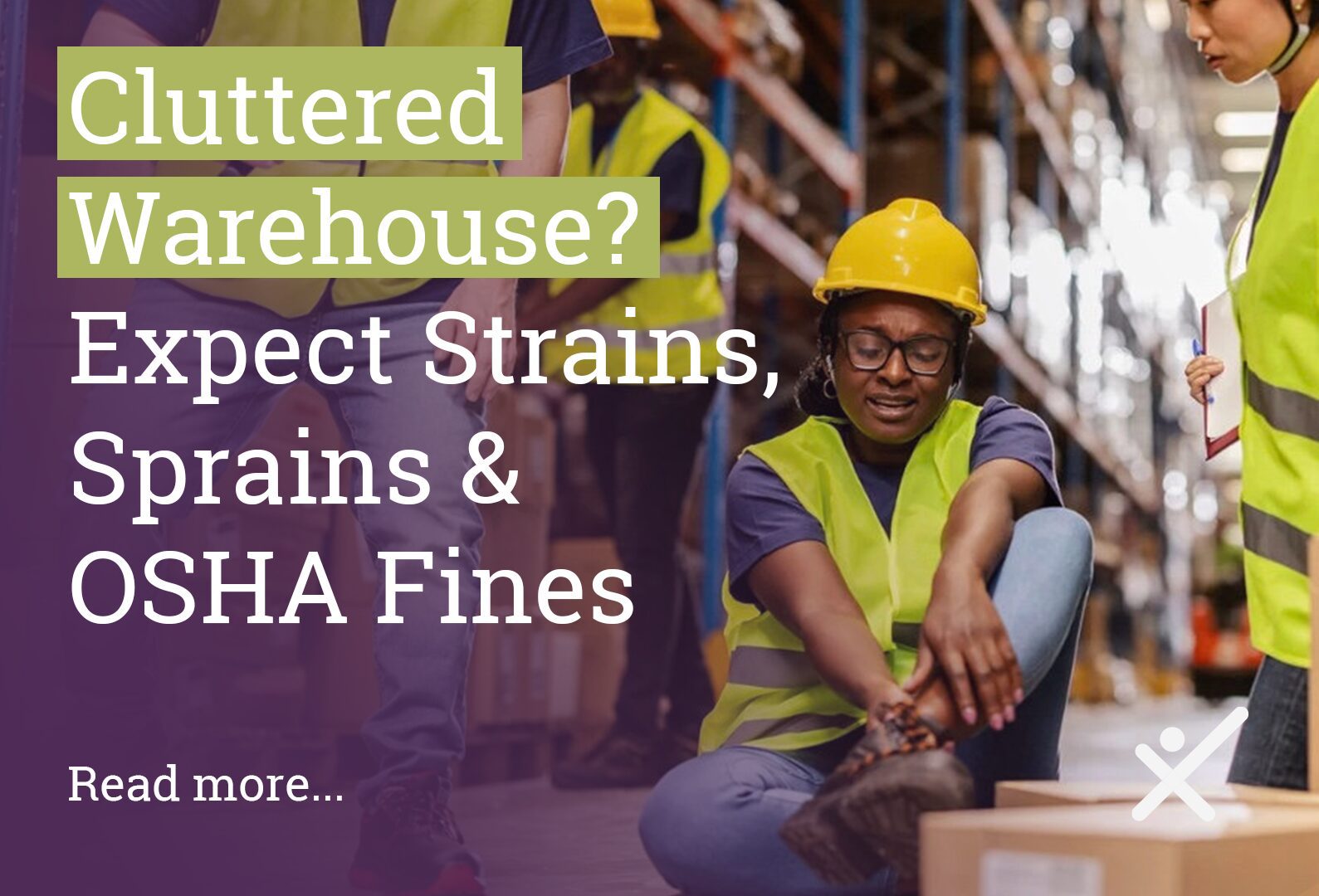
It’s easy to view workplace housekeeping as a cosmetic issue — something that makes a facility look neat or messy. But in industrial, warehouse, and retail settings, clutter creates real safety hazards. Obstructions and mess don’t just slow people down — they increase strains, sprains, slips, trips, falls, and other injuries. They also drive up OSHA inspection citations more quickly than almost any other issue.
Strains and sprains are the number-one cause of lost-time injuries. Slips, trips, and falls come right after. Walk through a warehouse where aisles are clogged with pallets and carts, racks are packed with overflow, and people regularly “temporarily” drop boxes in front of fire extinguishers and exits — and you’re in a place where musculoskeletal injuries and OSHA fines are practically inevitable.
We’ll unpack how clutter becomes both a safety issue and a compliance issue, examine case studies of companies that have learned these lessons the hard way, and discuss what employers can do to prevent injuries and maintain compliance with OSHA regulations.
If workers have to step over boxes, pivot around carts, squeeze past racks, or steady product before it topples over, their bodies pay the price. Clutter forces people into awkward postures: bending, reaching, twisting, or lifting in ways that place unusual stress on joints and soft tissues. When workers are surrounded by clear, open space, they can move with the habits and mechanics they learned in training. When they work in clutter, even the best-trained lifters can find themselves automatically adopting unsafe positions.
Clutter also increases slips, trips, and falls. Blocked aisles or walkways mean people constantly adjust their balance, take shorter steps, or rush to get past obstructions. Awkward movements combined with the need to hurry are a recipe for injuries.
Clutter is often the root cause of OSHA’s two most commonly issued housekeeping violations:
Put another way, clutter is a violation.
OSHA inspectors visited a Texas Family Dollar store and found blocked exits, obstructed aisles, unstable box stacks, and fire extinguishers hidden behind clutter. Total: three repeat violations, nearly $300,000 in penalties.
The problem wasn’t limited to one store. Dollar Tree/Family Dollar was cited in over 500 inspections since 2017, with dozens citing problems related to housekeeping.
A similar, multi-store retailer has OSHA penalties exceeding $15 million across several states. Three stores in Florida and Alabama alone were cited for over $400,000 in penalties after blocked emergency routes and hazardous stockrooms were found.
What’s interesting is that these weren’t exotic, complex violations. Dollar Tree/Family Dollar was cited for basic housekeeping problems over and over — to the point OSHA eventually considered them “systemic” within the company.
Dollar General has been cited for more than $21 million in penalties for hundreds of inspections involving blocked exits, inaccessible fire extinguishers, and unsafe storage. Most recently, the company agreed to a $12 million settlement in 2024 in which they promised to correct all hazards within 48 hours of identification or pay up to $500,000 per violation.
A Walmart distribution center in New York was cited for unstable pallet storage. A reminder OSHA expects the same stability in warehouses, distribution centers, and manufacturing plants as they do in small retail locations. If your storage is not stable, OSHA considers it out of compliance.
All these cases have one thing in common. Cluttered, obstructed spaces cause people to lift, carry, push, and pull in unnatural, awkward ways that increase the risk of strains and sprains. It also creates trip hazards, limits visibility, and forces workers to maneuver loads in cramped conditions. Toppling loads and unstable stacks introduce a powerful instinct people can’t resist: the urge to “save” a falling box.
Housekeeping failures increase ergonomic risks, slip/trip hazards, struck-by hazards, and OSHA violations. It is one of the quickest ways to increase injury rates — and one of the easiest hazards to eliminate.
Let’s go over some concrete, actionable steps employers can take. These aren’t difficult. They don’t require new equipment or facilities. But they do take diligence and consistency.
H3-Train Employees on Safe Lifting, Carrying, Pushing, and Pulling — and Create an Environment Where Good Mechanics Are Possible
You can train employees to practice perfect lifting mechanics throughout the day. But if they’re lifting in confined spaces or working around clutter, good mechanics become physically impossible.
Their environment should also enable this. Blocked aisles or encroaching clutter forces even properly trained workers to make unsafe movements. This is why housekeeping and ergonomics are so closely linked.
Unstable loads cause injuries in two ways. First, they can fall and strike people below. Second, they cause people to make sudden, awkward motions when trying to catch, steady, or prevent a fall.
Load stability is determined by the following:
Training workers to recognize unstable loads allows them to treat them as “stop and fix” conditions — and it starts with proper stacking.
Materials can be interlocked or “brick-stacked” to create stronger, more stable stacks by staggering boxes so the vertical seams don’t align. The concept is identical to why brick walls are so strong. The goal is simple: never build a stack that could split straight down the middle.
It begins with a solid foundation. The pallet should be level and sitting flat on firm ground. The bottom boxes should be the heaviest, strongest ones. The first layer must be tight, square, and without gaps because all the stability on top relies on it.
Then, when building the second layer, workers offset each box by roughly a half box-width, or rotate it 90 degrees. This breaks up vertical seams and makes the whole stack far more stable. Alternating this pattern with each additional layer distributes weight across more boxes, rather than allowing the whole stack to shear vertically.
It’s also critical each layer is as flat and even as possible. If a box is crushed, deformed, or unstable on one layer, it can destabilize everything above it. Crushed, uneven layers are when stacks start to lean, which puts them one push or vibration away from collapse.
Exceptions exist. Brick-stacking isn’t well-suited for flimsy, easily damaged boxes. It can also interfere with automated material handling or need for consistent size boxes for racking. In those cases, column-stacking with proper wrapping is safer.
If employees know what stable stacking looks like, and they know what an “ugly” stack is, they’re more likely to spot and correct hazards.
A good rule of thumb is when in doubt, break down loads. If a load is too heavy, too awkward, too high, too low, or obstructing their view, workers should break it down into smaller, more manageable loads. Even if a load is unstable or lifting requires working in a confined space, workers should take a moment to break it down to prevent strains and sprains.
Breakdown loads should be a normal part of the workflow, not something only done in response to being overloaded or out of shape.
One of the most powerful habits a workplace can instill is also one of the simplest. If you see a blocked pathway, door, or exit, you stop and you fix it. Workers shouldn’t be walking around hazards, stepping over boxes, or squeezing around pallet jacks “just this once.”
Employees need to know they won’t be chastised for stopping their work to remove a hazard. And the facility needs visual cues so it’s obvious what “blocked” looks like (marked aisles and pathways, “no storage zones,” staging areas, etc.). Ideally, employees know where to “dump” materials, or know exactly what to do if the staging areas are full.
A single habit like this can prevent hundreds of strains, sprains, and violations.
Clear, tidy spaces reduce injuries. They keep people moving naturally and efficiently. They reduce awkward lifting and reaching. They eliminate many slip and trip hazards. They keep OSHA from targeting you in inspections. Most importantly, they prevent chronic, systemic violations that have cost multi-national retailers tens of millions of dollars.
Housekeeping is not just tidy work, it’s an investment in safety, efficiency, and compliance.
Schedule your free consultation to learn how ErgoScience can help you lower injury rates, reduce costs, and keep your workers safe.
Be sure to check out the first article in our OSHA series: https://ergoscience.com/updates/osha-fines-and-ergonomic-risks-how-to-prevent-the-costliest-workplace-injuries-in-2025/

Share:
We'd Love to Chat!


ErgoScience makes the workplace better by applying evidence-based injury prevention through proven, defensible methodologies.

Proudly built by Adam Black Media Copyright © All rights reserved.
Our goal is to help people in the best way possible. this is a basic principle in every case and cause for success. contact us today for a free consultation.