

Executive Summary
An employee may be medically cleared to return to work, but are they physically ready to perform the job safely?
What Does Fitness-for-Duty Testing Assess?
Fitness-for-duty testing evaluates whether an employee’s demonstrated physical capabilities align with the essential demands of their job. It supports return-to-work decisions by identifying whether full duties, modified duties, work conditioning, or further assessment may be appropriate, alongside medical guidance and applicable restrictions.
For employers managing physically demanding roles, the gap between medical clearance and actual work readiness can increase reinjury risks and drive avoidable costs.
For employers, the immediate challenge is deciding whether an employee can resume essential tasks, requires modified duties, or needs further assessment, without unnecessarily delaying a safe return.
These findings help employers determine whether employees can resume full duties, require temporary restrictions or modified work, or need further conditioning before returning to their regular responsibilities.
According to Liberty Mutual’s 2025 Workplace Safety Index, the ten leading causes of serious workplace injuries cost U.S. employers an estimated $50.87 billion annually, with overexertion accounting for $13.7 billion.
This guide explains how fit-for-duty testing helps employers evaluate work readiness, manage physical limitations, and make job-specific return-to-work decisions that support employee safety and operational continuity.
Why Fitness-for-Duty Testing Matters for Employers
For employers managing physically demanding workforces, medical recovery does not always mean an employee is ready to resume full duties. Fit-for-duty testing evaluates whether employees can safely meet their job’s physical requirements and helps employers make informed return-to-work decisions.
The financial impact is significant. According to Liberty Mutual’s 2025 Workplace Safety Index, overexertion injuries cost U.S. employers an estimated $13.7 billion annually.
Fitness-for-duty testing offers several benefits:
- Reduce Reinjury Risk: Identify physical limitations that could affect safe job performance before employees resume full duties.
- Control Workers’ Compensation Costs: Help reduce avoidable claims, treatment expenses, and lost workdays through informed work assignments.
- Assess Work Readiness: Evaluate strength, mobility, and endurance against essential job demands to determine whether employees are ready for full or modified duties.
- Support Timely Returns: Identify suitable modified duties when employees are not yet fit to work at full capacity.
- Improve Decision-Making: Use standardized, job-specific criteria to support consistent assessments, appropriate restrictions, and follow-up.
Ultimately, fit-for-duty testing helps employers balance employee safety with operational needs. A structured assessment process provides a foundation for more informed work-readiness decisions and safer returns to physically demanding jobs.
How to Implement ErgoScience’s JobFit Validation Framework for Fitness-for-Duty Testing
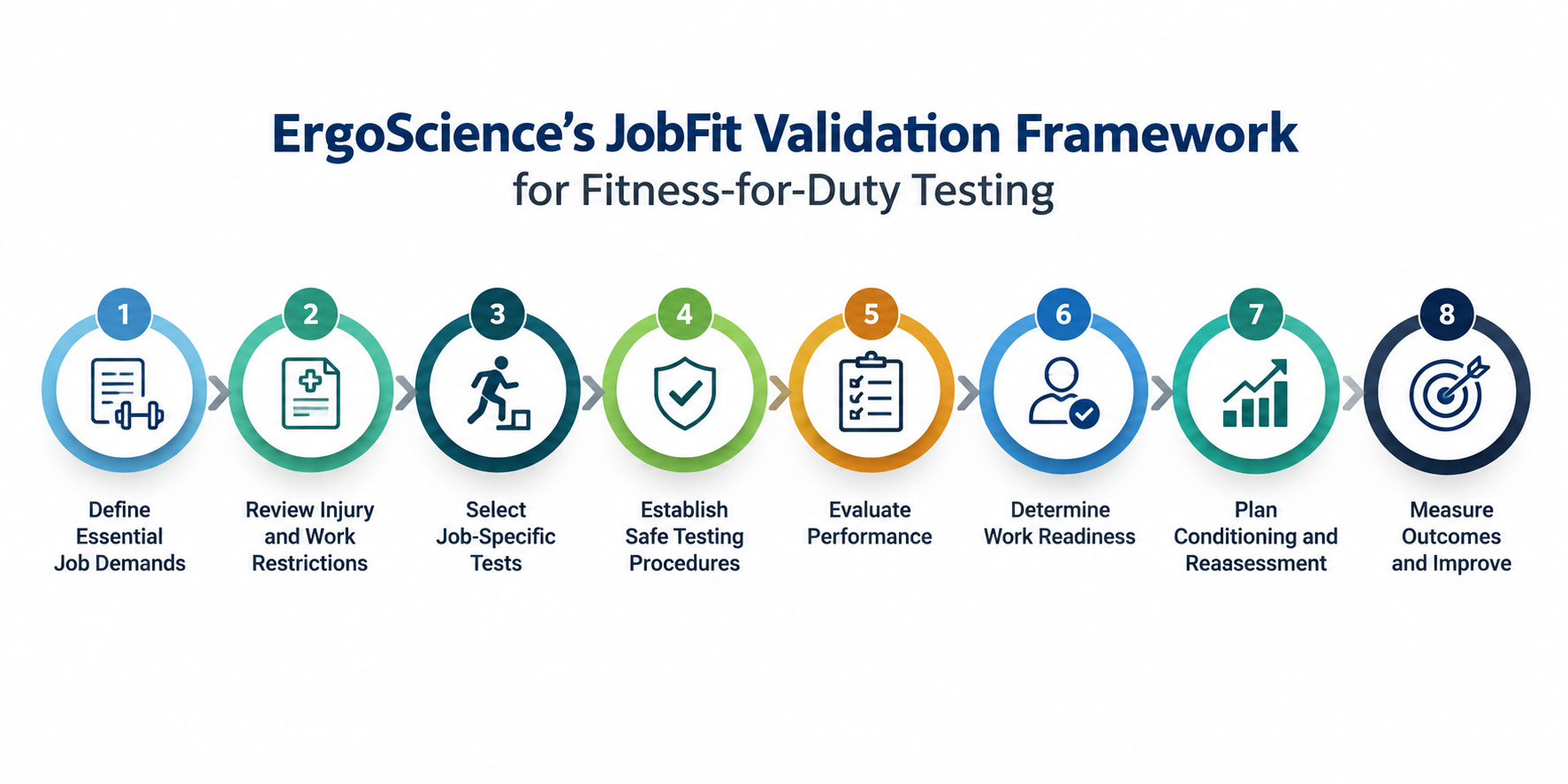
ErgoScience’s JobFit Validation Framework provides a structured approach to assessing whether injured employees can safely resume their regular duties. By connecting documented job demands, research-backed physical testing, and objective evaluation criteria, employers can make more informed fitness-for-duty decisions, reduce reinjury risks, and support safe returns to work.
One important consideration is keeping job-demand information current. When equipment, production requirements, or workflows change, employers should review the testing criteria to ensure assessments continue to reflect actual job requirements.
- Define Essential Job Demands
- Review Injury and Work Restrictions
- Select Job-Specific Tests
- Establish Safe Testing Procedures
- Evaluate Performance
- Determine Work Readiness
- Plan Conditioning and Reassessment
- Measure Outcomes and Improve
Step 1: Define the Job’s Essential Physical Demands
What it is
Document the actual physical requirements of the employee’s role. This provides the foundation for selecting relevant fit-for-duty tests and determining whether an employee can safely perform essential job functions.

How to implement it:
- Observe Actual Tasks: Examine lifting, carrying, pushing, pulling, repetitive movements, and sustained postures under real working conditions.
- Measure Physical Demands: Document strength, endurance, movement patterns, task frequency, and workload requirements. Distinguish essential job functions from duties that may be temporarily modified.
Step 2: Review the Employee’s Injury and Work Restrictions
What it is
Understand the employee’s current functional limitations and applicable medical restrictions before designing an assessment. This helps ensure fitness-for-duty testing reflects relevant job demands without exposing the employee to unnecessary risk.
How to implement it:
- Review Medical Guidance: Consider relevant medical documentation and restrictions, coordinating with treating providers when clarification is needed. Protect confidential information and follow applicable privacy requirements.
- Identify Testing Needs: Determine which physical capabilities require assessment and which activities may be inappropriate. Seek appropriate professional guidance when medical restrictions or safety concerns require it.
Step 3: Select Job-Specific Fitness-for-Duty Tests
What it is
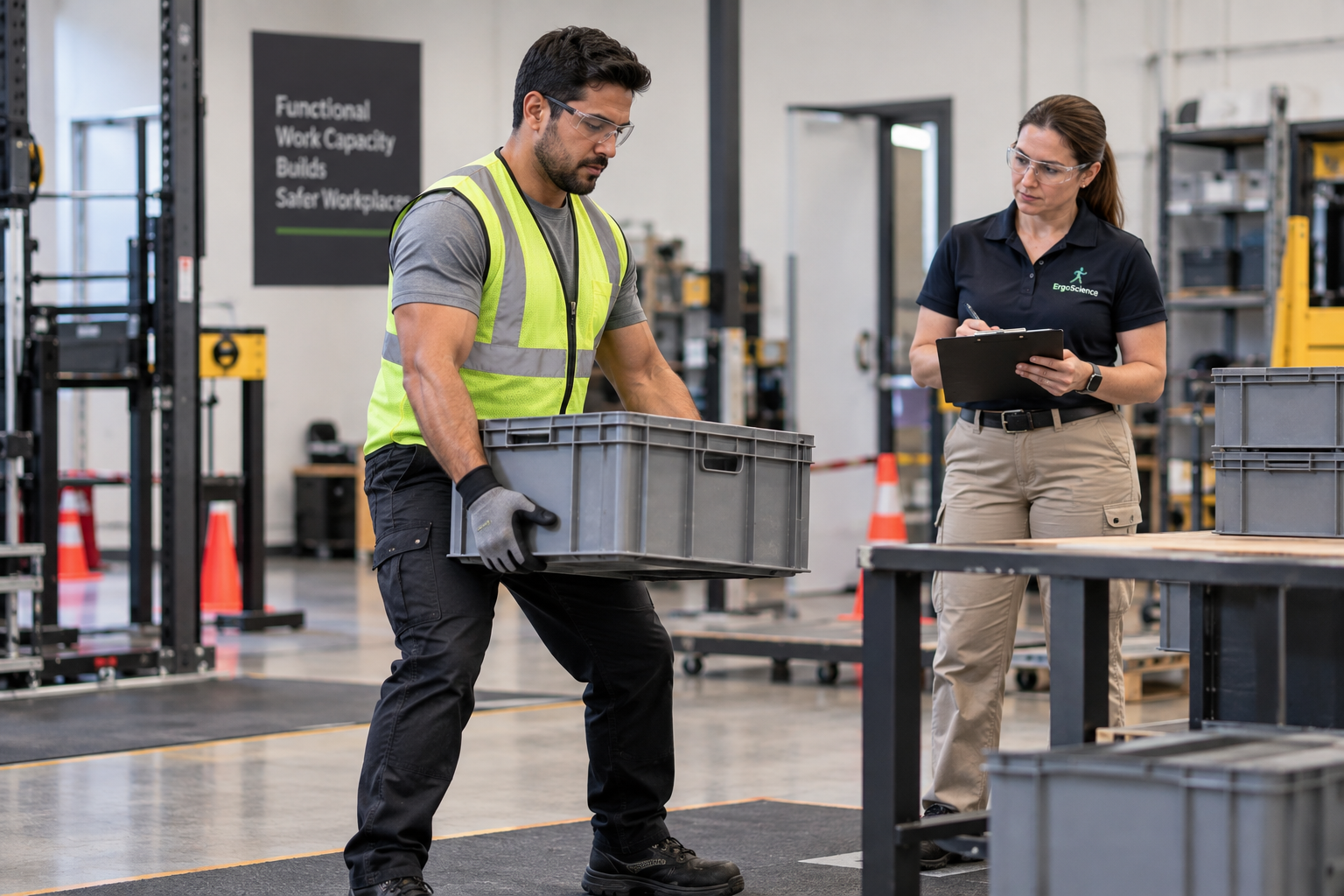
A fit-for-duty test should measure the physical capabilities required for an employee’s specific role. Research-backed, job-specific testing provides a reliable basis for evaluating fitness for duty and determining work readiness.
How to implement it:
- Match Tests to Tasks: Select an assessment that reflects essential activities, such as lifting, carrying, pushing, pulling, and sustained exertion. Link each test item and passing criteria to a documented job requirement.
- Validate Testing Criteria: Use reliable assessment methods with established scoring criteria to ensure tests accurately measure relevant capabilities and support appropriate employment decisions.
Step 4: Establish Safe and Standardized Testing Procedures
What it is
Define how fitness-for-duty tests will be administered, measured, and documented. Standardized procedures promote consistency across employees and locations while helping qualified personnel recognize when testing should stop.
How to implement it:
- Standardize Test Conditions: Establish consistent instructions, equipment, measurement methods, and testing sequences. Document deviations that could affect results.
- Define Safety Criteria: Establish stopping rules for pain, cardiovascular distress, or other concerning responses. Ensure personnel can respond appropriately and document incomplete assessments accurately.
Step 5: Evaluate Performance Against Documented Job Requirements
What it is
Compare the employee’s demonstrated capabilities with documented job demands. Objective, job-related criteria help identify capability gaps and support consistent fitness-for-duty decisions.
How to implement it:
- Compare Results Objectively: Evaluate performance against established requirements for essential job tasks rather than relying solely on subjective impressions or comparisons with other employees.
- Document Assessment Findings: Record results, limitations, incomplete tests, and the criteria used to interpret performance. Explain how findings relate to essential job functions and current restrictions.
Step 6: Determine Work Readiness and Appropriate Restrictions

What it is
Use assessment findings alongside relevant medical guidance to determine whether an employee is ready for full duties, needs modified work, work conditioning, or requires further evaluation. Fitness-for-duty testing informs these decisions but does not replace medical judgment.
How to implement it:
- Assess Full-Duty Readiness: Determine whether demonstrated capabilities meet essential job requirements and applicable restrictions. Refer unresolved medical concerns to the appropriate healthcare professional.
- Identify Modified Duties: Identify suitable tasks that match the employee’s current capabilities and restrictions. Coordinate arrangements with HR, safety, relevant providers, and operations as appropriate.
Who Is Responsible for Determining an Employee’s Fitness for Duty?
Fitness-for-duty testing evaluates whether an employee’s demonstrated physical capabilities align with the essential demands of their job. It supports return-to-work decisions by identifying whether full duties, modified duties, work conditioning, or further assessment may be appropriate, alongside medical guidance and applicable restrictions.
Step 7: Plan Conditioning and Follow-Up Assessments
What it is
Establish a plan for employees who have not yet demonstrated the capabilities required for full duties. Appropriate conditioning, modified work, and reassessment can help improve work readiness and support a safe return.
How to implement it:
- Address Capability Gaps: Identify unmet physical requirements and consider appropriate work conditioning, rehabilitation guidance, or temporary duty modifications based on professional recommendations.
- Schedule Reassessment: Set review points based on recovery progress, restrictions, and job requirements. Repeat relevant assessments when changes in capability or other circumstances justify reassessment.
What Should Employers Do When an Employee Fails a Fitness-for-Duty Test?
When an employee does not meet the physical requirements of a fitness-for-duty assessment, employers should review the findings alongside medical guidance and applicable restrictions. Depending on the identified limitations, options may include modified duties, appropriate work conditioning, or further evaluation. Reassessment can help determine when the employee is ready to resume full duties.
Step 8: Measure Outcomes and Refine the Process
What it is
Evaluate whether fit-for-duty testing supports safer returns to work and reduces avoidable operational disruption. Tracking outcomes helps employers identify improvement opportunities and strengthen their injury-prevention strategy.
How to implement it:
- Track Injury Outcomes: Monitor reinjuries, lost workdays, repeat claims, and time spent on modified duties. Compare results against a consistent baseline to identify meaningful trends.
- Evaluate Program Effectiveness: Review injury-related costs, assessment consistency, and workforce outcomes across locations. Use findings to refine testing protocols, address recurring capability gaps, and assess return on investment.
Establish a consistent measurement period and document the program changes made during that time. This helps employers interpret outcome trends and assess the program’s contribution to improved workforce safety.

How Often Should Employers Review Their Fitness-for-Duty Testing Program?
Employers should review their fitness-for-duty testing program annually or whenever job demands, equipment, workflows, or workplace conditions change. Periodic reviews of reinjuries, lost workdays, modified-duty duration, and workers’ compensation costs can also help identify gaps and improve testing effectiveness.
Applying the JobFit Validation FrameworkTM Across Your Workforce
The JobFit Validation FrameworkTM connects job analysis, physical testing, and follow-up to support consistent fitness-for-duty decisions across multiple locations. It helps employers assess work readiness, document findings, and identify opportunities to reduce injury risks.
ErgoScience connects documented job demands with job-specific physical abilities testing and return-to-work fitness-for-duty testing, helping employers evaluate physical capabilities against the essential tasks employees must perform. The following examples show how these practices can be applied across physically demanding industries.
Fitness-for-Duty Testing in Practice: Two Industry Examples
The following two examples illustrate how job-specific physical assessments support workforce decisions. The first includes return-to-work testing; the second concerns pre-hire physical abilities testing.
Example 1: Reducing Injuries and Supporting Safe Returns in Warehousing
An automotive-parts warehouse experienced rising strains, sprains, and falls, particularly among employees in their first six months.
- The challenge: Job demands had changed as automobile parts became larger and heavier than the employer realized.
- The response: ErgoScience conducted job analyses, revised lifting restrictions, and developed job-specific physical abilities tests. The company also introduced return-to-work/fitness-for-duty testing to assess whether employees recovering from musculoskeletal injuries or surgery were fit to work safely after an absence of more than 30 days.
- The results: Average annual injuries decreased by 89%, and average annual direct injury costs fell by 90%, with net savings exceeding $2 million.
Example 2: Addressing Musculoskeletal Injuries in Meat Processing
A large meat-processing company faced rising musculoskeletal injury rates and costs, particularly among newly hired employees.
- The challenge: Physically demanding work increased the risk of strains and other injuries.
- The response: ErgoScience implemented pre-hire physical abilities testing for 2,774 applicants across two locations over two years.
- The results: Research cited by ErgoScience found low-back injuries among workers who passed pre-hire testing occurred at a rate of 3%, compared with 33% among untested workers, a reported 90% improvement.
This example demonstrates the value of matching physical capabilities to documented job demands in pre-hire testing. Although it is not a return-to-work fitness-for-duty case, it illustrates the job-specific assessment principle used in both applications.
These examples highlight the value of understanding job demands and assessing physical capabilities. For employees recovering from injuries, fitness-for-duty testing can help employers evaluate work readiness and determine whether an employee is fit to work safely, whether modified duties are needed, or whether further conditioning may be appropriate.
Best Practices for Effective Fitness-for-Duty Testing
Effective fit-for-duty testing requires more than assessing physical capabilities. Employers need consistent, job-specific criteria and clear coordination between teams to support safe, defensible return-to-work decisions and evaluate employee work readiness.
The following practices can help strengthen your approach.
- Base Testing on Documented Job Demands: Build assessments around observed job tasks and measurable physical requirements, not generic job descriptions or assumptions about the role.
- Coordinate Safety, HR, Risk, and Medical Teams: Define responsibilities for testing, restrictions, work assignments, and follow-up to prevent conflicting decisions and gaps in return-to-work coordination.
- Use Objective, Job-Related Evaluation Criteria: Establish assessment methods and scoring thresholds before testing so results can be compared consistently against essential physical job requirements.
- Distinguish Medical Clearance From Physical Job Readiness: Consider whether demonstrated capabilities match actual job demands, alongside medical guidance and applicable restrictions, before determining whether an employee is fit to work safely.
- Establish Clear Modified-Duty Pathways: Identify alternative jobs and tasks that accommodate current limitations while maintaining operational value, and define when restrictions should be reviewed or reassessed.
- Protect Employee Privacy and Document Decisions: Restrict access to sensitive medical information, document job-related findings, and record the rationale for restrictions and return-to-work decisions.
- Track Outcomes Beyond Claim Closure: Monitor reinjuries, lost workdays, modified-duty duration, workers’ compensation costs, and program ROI to identify opportunities for improvement.
Applying these practices helps employers make more consistent fitness-for-duty decisions while balancing employee safety, workforce availability, and operational requirements.
Next, let’s examine common mistakes that can undermine testing accuracy and create avoidable return-to-work risks.
Common Fitness-for-Duty Testing Mistakes to Avoid
Poorly designed fitness-for-duty testing can increase reinjury risks, delay returns to work, and create inconsistent employment decisions. Employers can avoid these issues by addressing the following mistakes.
| Common Mistakes | What You Should Do |
| Relying Only on Medical Clearance | Assess physical capabilities against essential job demands alongside medical guidance. |
| Using Generic Tests | Select job-specific tests based on documented tasks and validated criteria. |
| Ignoring Physical Job Demands | Identify actual lifting, carrying, pushing, pulling, and endurance requirements. |
| Returning Employees Too Soon | Confirm readiness against job requirements and applicable restrictions before resuming full duties. |
| Maintaining Restrictions Without Reassessment | Set review criteria and reassess as capabilities and recovery progress change. |
| Failing to Document Results | Record testing criteria, findings, limitations, and the rationale for decisions. |
| Tracking Claims Alone | Monitor reinjuries, lost workdays, modified-duty duration, and workers’ compensation costs. |
Avoiding these mistakes helps employers make safer, more consistent return-to-work decisions. Use the following checklist to assess whether your current process covers these critical areas.
Fitness-for-Duty Testing Checklist for Employers
A structured fitness-for-duty testing process helps employers assess physical job readiness, manage work restrictions, and support safe return-to-work decisions. Use this checklist to identify gaps in your current process.
| Stage | Checklist Item |
| Before Testing | |
| ☐ | Document essential job tasks and physical demands. |
| ☐ | Review relevant medical guidance and work restrictions. |
| ☐ | Select job-specific tests with established evaluation criteria. |
| During Testing | |
| ☐ | Follow standardized testing procedures and safety protocols. |
| ☐ | Monitor employee responses and stop testing when necessary. |
| ☐ | Record results and any incomplete assessments. |
| After Testing | |
| ☐ | Compare results against documented job requirements. |
| ☐ | Determine readiness for full or modified duties. |
| ☐ | Document findings, restrictions, and job-related decision rationale. |
| Return-to-Work Follow-Up | |
| ☐ | Establish reassessment criteria and review dates. |
| ☐ | Monitor reinjuries, lost workdays, and modified-duty duration. |
| ☐ | Review workers’ compensation costs and program outcomes. |
Use this checklist to strengthen your fitness-for-duty process, improve work-readiness decisions, and support safer returns to physically demanding jobs. Regularly reviewing outcomes also helps identify opportunities to improve injury prevention and workforce performance.

Help Employees Return to Work Safely With ErgoScience
A structured fit-for-duty testing process helps employers evaluate employee capabilities against essential job demands and make more informed return-to-work decisions. This approach supports safer work assignments while balancing employee recovery with operational requirements.
ErgoScience’s JobFit Validation Framework™ connects job analysis, job-specific physical testing, and objective performance evaluation to help employers make informed fitness-for-duty decisions. When employees are not ready for full duties, conditioning, modified work, and follow-up assessments help address capability gaps and support safer returns.
- Reduce Reinjury Risk: Verify physical readiness against job demands.
- Control Injury Costs: Help limit avoidable claims and lost productivity.
- Facilitate Safe Returns: Identify suitable modified duties and conditioning needs.
- Strengthen Decisions: Use objective, job-specific assessment criteria.
Partner with ErgoScience to apply the JobFit Validation Framework, evaluate employee work readiness, and support consistent return-to-work decisions across physically demanding roles and multiple locations.
Ready to determine whether your employees are physically prepared to return to work safely?
Frequently Asked Questions
1. What does fitness-for-duty testing assess?
Fit-for-duty testing assesses whether an employee can safely perform the physical demands of their job, including lifting, carrying, pushing, pulling, and endurance tasks. The tests should reflect documented job requirements and help identify any limitations affecting work readiness.
2. How is fitness-for-duty testing different from medical clearance?
Medical clearance addresses an employee’s medical status, while fitness-for-duty testing evaluates their physical capabilities against specific job demands. Together, these can inform return-to-work decisions, alongside applicable restrictions and medical guidance.
3. When should an employee undergo fitness-for-duty testing?
Fit-for-duty testing may be appropriate before an employee returns to physically demanding work following an injury or illness, particularly when their ability to perform essential job tasks is uncertain. Testing should be guided by job requirements, relevant medical advice, and applicable workplace policies.
4. What happens if an employee is not fit to work?
If an employee cannot yet meet the physical demands of their role, the assessment may identify a need for modified duties, temporary restrictions, or work conditioning. Follow-up assessments can help determine when the employee is ready to resume full duties safely.
Related Articles
- How to Strengthen a Return-to-Work Program
- Physical Abilities Testing
- ADA-Compliant Physical Ability Tests
- Reduce Injury Risk With Job Task Analysis