
Schedule an Ergonomic Assessment
Work-related musculoskeletal disorders (MSDs) are among the most frequently reported causes of lost or restricted work time. Nearly 500,000 workers suffer from work-related MSDs, which account for over one-third of all workplace injuries.
(1) Before the coronavirus pandemic, work-related MSDs followed a flat trend. However, the current work-related non-fatal injury rate surpasses pre-pandemic levels.
(2)For organizations with physically demanding jobs, reducing this risk requires more than teaching employees proper ergonomic lifting techniques.
Effective workplace injury prevention starts with understanding the physical demands of the job, then determining which ergonomic lifting techniques are appropriate for the worker, load, and task.
1. What Makes Ergonomic Lifting Techniques Different for Different Jobs?
Ergonomic lifting techniques vary because lifting demands differ across jobs. A warehouse worker handling boxes, a delivery worker moving packages, and a manufacturing employee handling components may face different load characteristics, lifting heights, reach distances, repetition, and workspace constraints. Effective ergonomic lifting techniques should therefore reflect the actual physical demands of each job rather than rely on one standardized method.
Over seven million working days are lost annually due to work-related MSDs, accounting for 24% of all lost workdays. These lost workdays negatively impact productivity and profitability. Back injuries comprise almost half of all work-related MSDs. When severe, they can be life-changing and significantly impact the quality of life for workers.
The most common causes of workplace MSDs include lifting. The Occupational Safety and Health Administration (OSHA) recommends training as an important intervention for these disorders.
However, some studies show that training alone may not prevent the occurrence of MSDs among frontline workers. One systematic literature review found no evidence to support training in working techniques for preventing back pain or consequent disability.
This is an important distinction for workplace injury prevention. Training employees in ergonomic lifting techniques can help them understand how to control a load and reduce unnecessary physical strain, but training does not automatically change the physical demands of the job. A lifting task may remain difficult because of its frequency, reach distance, load characteristics, workstation design, or other constraints.
While that advice is helpful in the most basic way, it does not address some important nuances of proper lifting.
Generic training teaches workers how to perform lifting techniques correctly, but it rarely reflects the actual loads, working heights, repetition, or workspace constraints they encounter. As a result, it may not be enough to change lifting behavior in real-world work settings.
This creates an important distinction between training the worker and reducing the physical demands of the task. Workplace injury prevention requires both. Employees need practical guidance on ergonomic lifting techniques, while employers also need to identify whether the job itself is creating unnecessary or excessive physical demands.
2. Can Ergonomic Lifting Techniques Reduce Workplace Injury Risk?
Ergonomic lifting techniques can help reduce physical strain, but technique alone does not eliminate workplace injury risk. Effective ergonomic lifting techniques should be combined with task-specific ergonomic assessments that identify excessive force, awkward postures, repetitive movements, and other physical demands. Employers can then address risks through training, workflow changes, equipment, or job redesign.
Even when an employee follows appropriate ergonomic lifting techniques, a task can still create substantial physical exposure. The worker may be lifting a heavy or bulky load repeatedly, reaching away from the body, working from an awkward height, twisting to transfer materials, or performing the same movement for several hours with limited recovery time.
The physical demands of lifting are influenced by more than technique. Load characteristics, force, repetition, reach distance, posture, duration, recovery time, workstation design, equipment, and environmental constraints can all affect the demands placed on the worker.
This is why workplace injury prevention should not focus exclusively on whether employees are following the “right” lifting posture. The more useful question is whether the organization has identified and addressed the conditions that make the task physically demanding in the first place.
Several factors influence proper lifting in real-world work settings:
There are several additional factors that determine which ergonomic lifting techniques are practical and how physically demanding a lift may become:
Together, these factors show why one lifting technique or a generic training exercise may not reflect the demands of the actual job.
Before selecting ergonomic lifting techniques or designing lifting training, Safety and EHS teams should understand what the job actually requires. A practical lifting-risk assessment can examine five areas:
This approach allows workplace injury prevention efforts to move beyond generic lifting instruction and identify where the physical demands of the job can actually be reduced.
There is no single lifting posture that is appropriate for every situation. The following principles provide a foundation for ergonomic lifting techniques, but the specific method should be selected based on the worker, load, task, and environment.
A practical lifting method should aim to achieve the following goals:
These principles can help reduce unnecessary physical stress during lifting and limit sudden, uncontrolled forces on the spine and surrounding tissues. Avoiding twisting while lifting can also help reduce physical stress when handling a load.
Pulling your navel toward your spine before any significant lifting is important because this action engages the transverse abdominal muscles that support your spine without causing it to flex. Breathing out reduces the elevation in blood pressure caused by holding your breath.
Following these principles can help reduce unnecessary physical stress on muscles, ligaments, and joints during lifting.
3. How Can Employers Make Ergonomic Lifting Techniques Part of Everyday Work?
Ergonomic lifting techniques are more effective when they are reinforced as part of everyday work rather than taught as a one-time exercise. Employers can reinforce ergonomic lifting techniques through job-specific coaching, task observation, feedback, and periodic reassessment. This helps employees apply appropriate techniques consistently as tasks, workloads, and work environments change.
As a physical therapist focused on workplace injury prevention, I have spent much of my career observing lifting occurring in the workplace. Often, we see the following problems, making a lift more stressful on the body:
These movements do not exist in isolation. Their significance can increase when they are repeated frequently, performed for long periods, combined with heavy or awkward loads, or made necessary by the design of the task. This is why observing ergonomic lifting techniques in the context of the actual job is important for workplace injury prevention.
The US Army has published an extremely comprehensive bulletin on safe lifting. (6) This communication relies heavily on their descriptions and diagrams combined with our 30+ years of teaching lifting techniques as physical therapists.
Let’s break it down, principle by principle.
To keep the load close, one must get the load between the knees. So, the feet must be placed wide enough apart to make this happen. Often, this requires a wider stance than most people are accustomed to. Also, the feet need to be staggered, with one foot slightly ahead of the other, so that you can use the body’s momentum in a smooth and controlled way to assist with the lift.
Most objects being lifted don’t have handles. To assist with keeping the load close, reach out with the same hand as the forward foot to grasp the front corner of the box/load. Put the opposite hand on the corner of the load closest to you.
Look up as you lift, drawing your navel into your spine. Keep your back as straight as possible while pushing your buttocks out behind you. Breathe out as you lift rather than hold your breath.
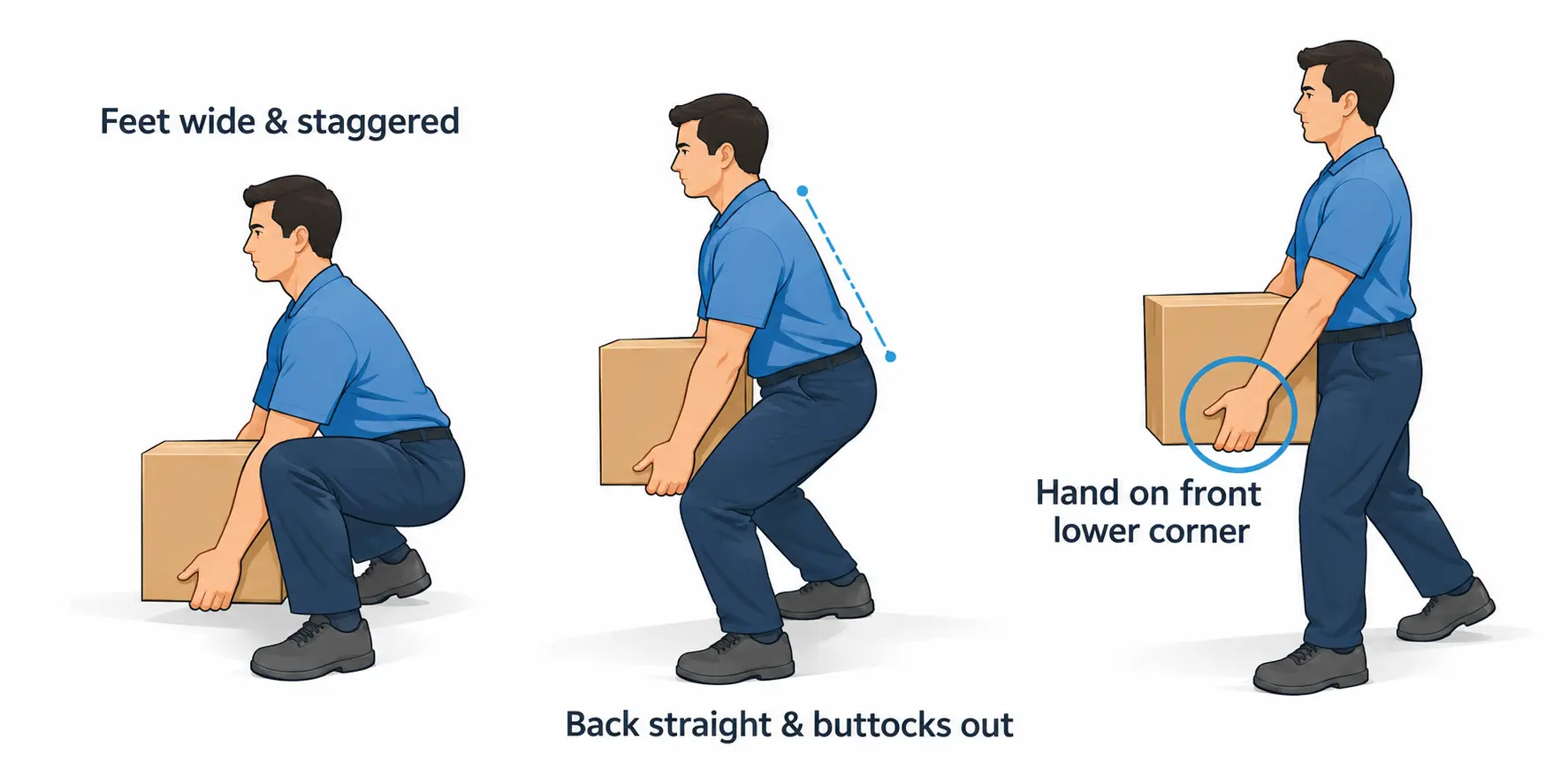
https://www.sfdph.org/dph/files/OSH/armylift.pdf (6)
The power lift is similar to the lift that professional weightlifters use. As with the squat lift, the feet are far apart and staggered, and the back is straight with the buttocks out. The grasp is also similar. The difference is that the knees and ankles do not bend as much. This is a good technique for those who lack knee and ankle flexibility.
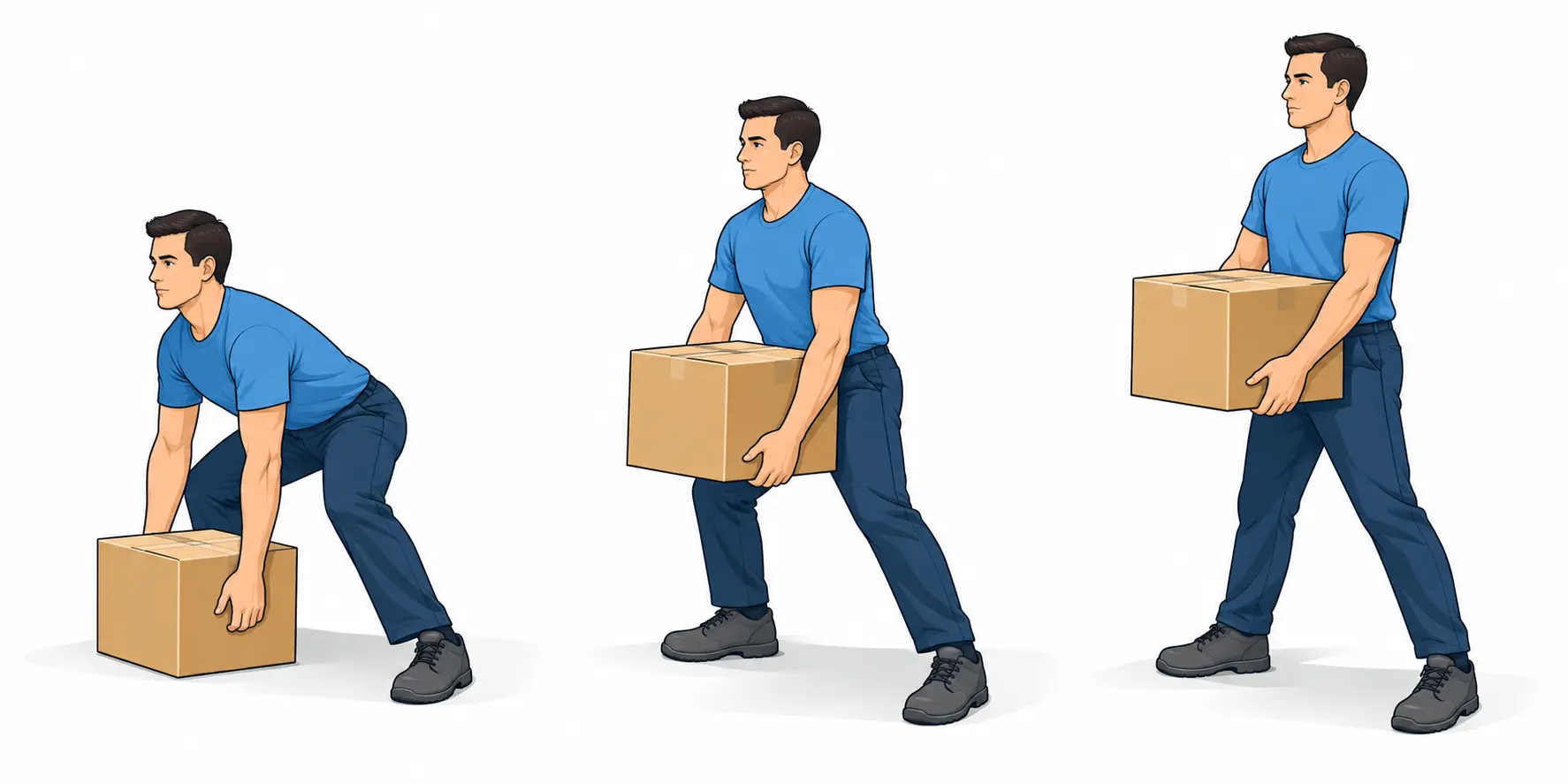
https://www.sfdph.org/dph/files/OSH/armylift.pdf (6)
The tripod lift can be good for several situations, such as if the load is uneven or odd-shaped or if knee and ankle mobility or arm strength are limited. However, it may not be the best technique for people with painful and tender knees. At least one knee must tolerate being on the ground in the initial phases of the lift.
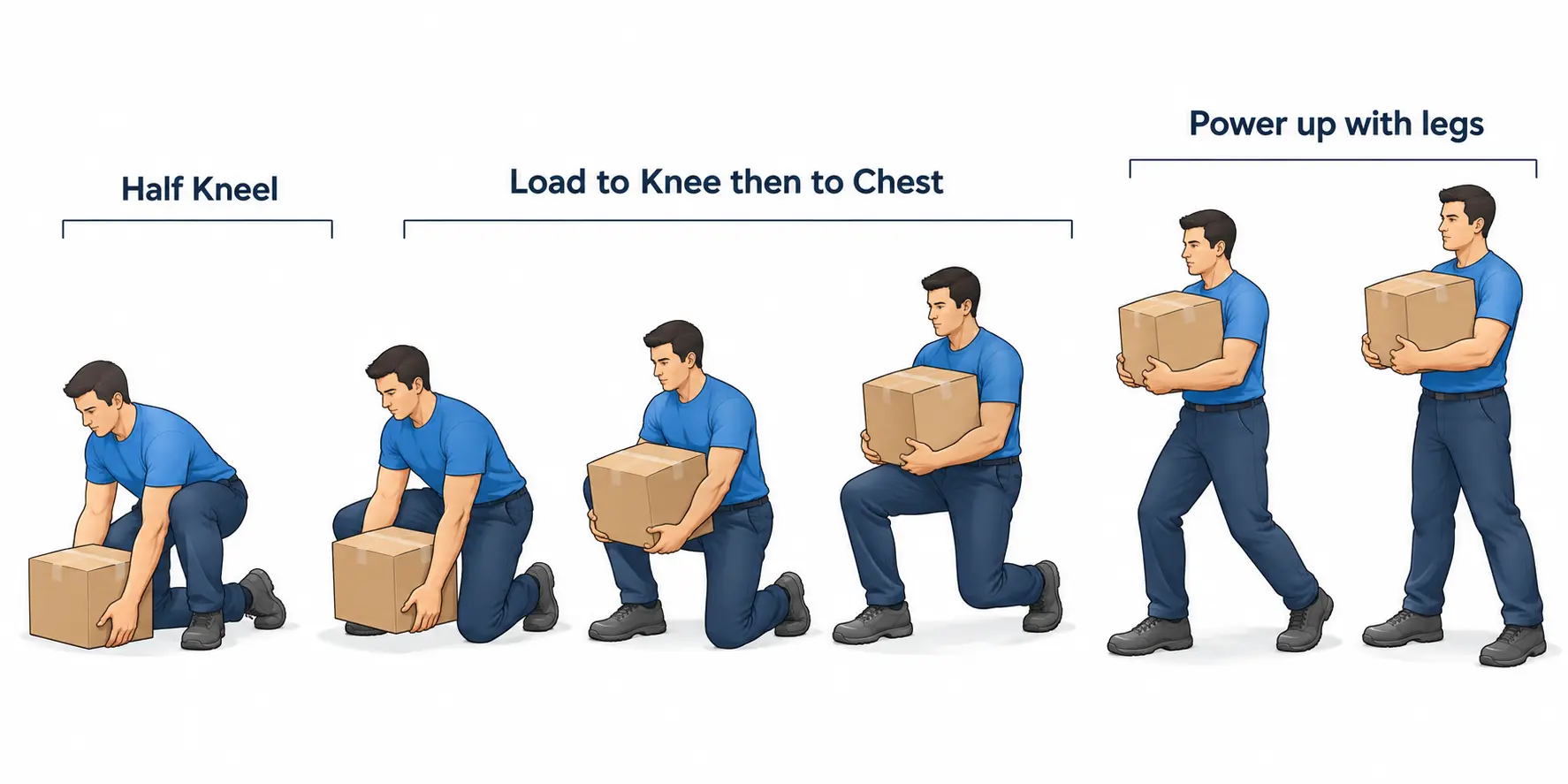
https://www.sfdph.org/dph/files/OSH/armylift.pdf (6)
Use the same principles of back straight, buttocks out, navel in, and abdominals tightened. One knee is on the ground, touching the object, the other out to the side or as close to the outside as possible. Slide or lift the object onto the “up” knee. Hug the object close to your chest with your forearms underneath. Look forward and breathe out as you lift.
Much confusion surrounds the words “engage/activate your core. Exactly what does that mean?
What’s the purpose of doing it? The purpose is to create a brace for your back by drawing your navel backward toward your spine and tensing the transverse stomach muscles. This increases the pressure inside your abdomen and protects the joints, ligaments, and discs in your back. (7)
Contracting the transverse abdominal muscles during lifting also helps activate the small multifidus muscles in your back, creating additional spine stability. When you do it correctly, your waist becomes smaller. You can get the feel of it by blowing air out through your mouth like you are blowing out birthday candles on a cake.
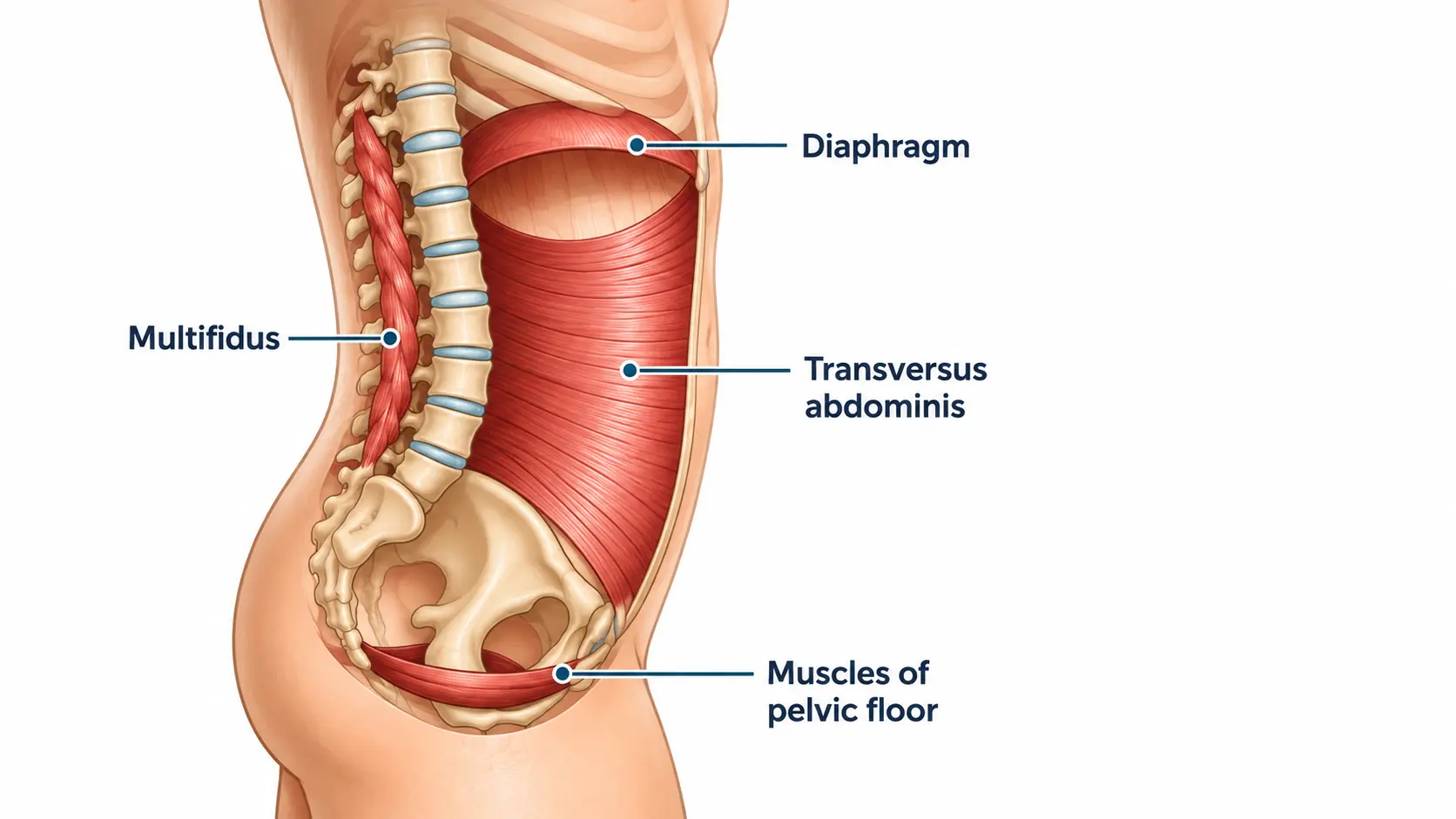
https://www.stacydockins.com/posture-lab/2019/4/30/say-hello-to-your-transverse-abdominis (8)
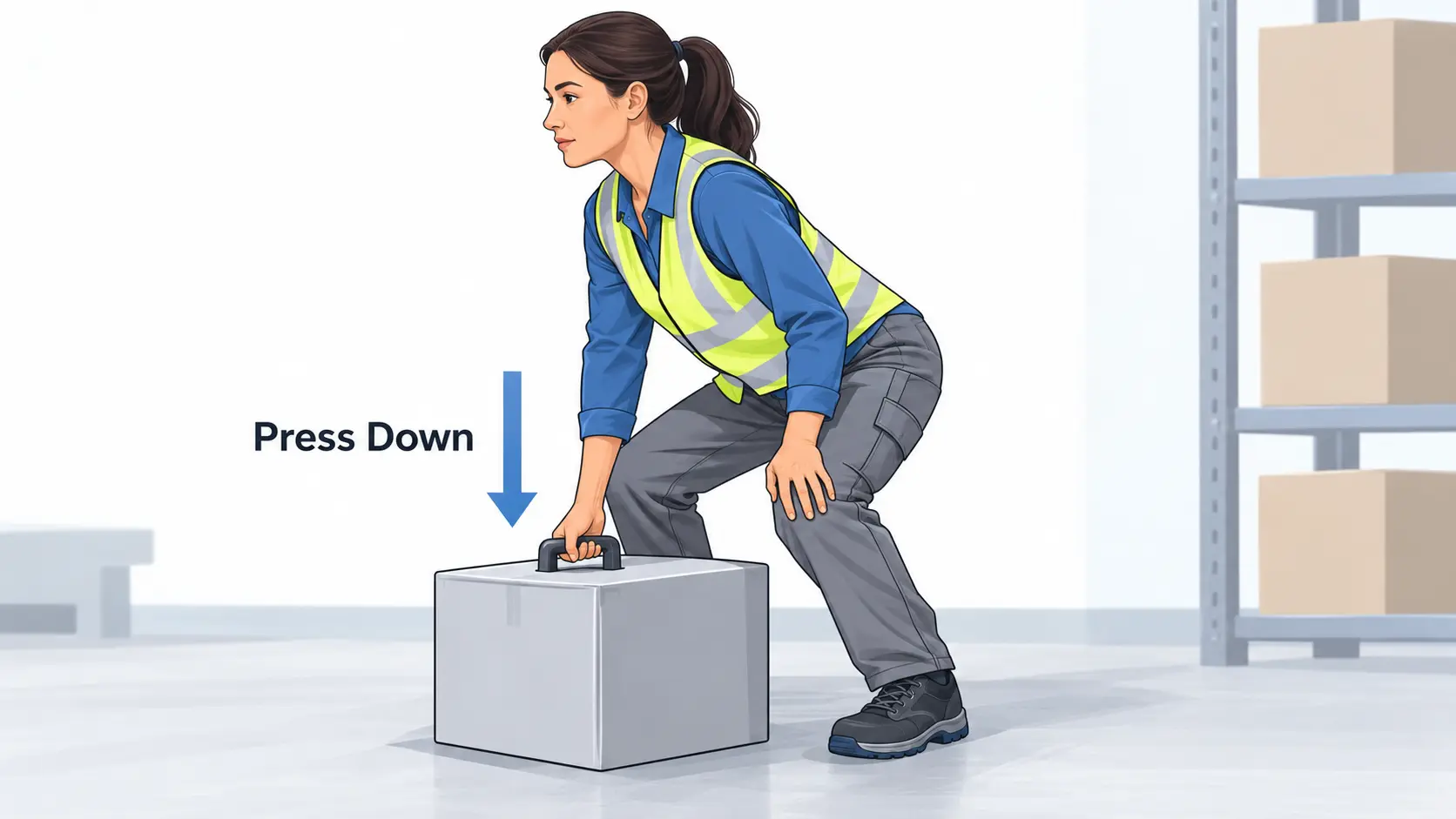
For one-handed lifting of an object with handles, use a partial squat: When lifting lighter objects with a handle, it’s tempting to revert to the stoop lift (straight knees, bent back). Instead, protect your back with a partial squat even in these less demanding tasks. Remember that back injuries are often cumulative, and you save your back any time you reduce the stress.
Stand with the object parallel to your side, with your feet shoulder-width apart and staggered as in the previous lifts. You can place one hand on your thigh for support as you lift. Keep your back straight and buttocks out (this should sound familiar by now), stomach tight, and breathe out as you lift.
https://www.sfdph.org/dph/files/OSH/armylift.pdf (6)
Sometimes the straight-leg lift is unavoidable – especially when obstacles prevent you from bending your knees. However, it is recommended that you use this technique only when there is no other way. The example below of a lift from the trunk of a car provides one such example.
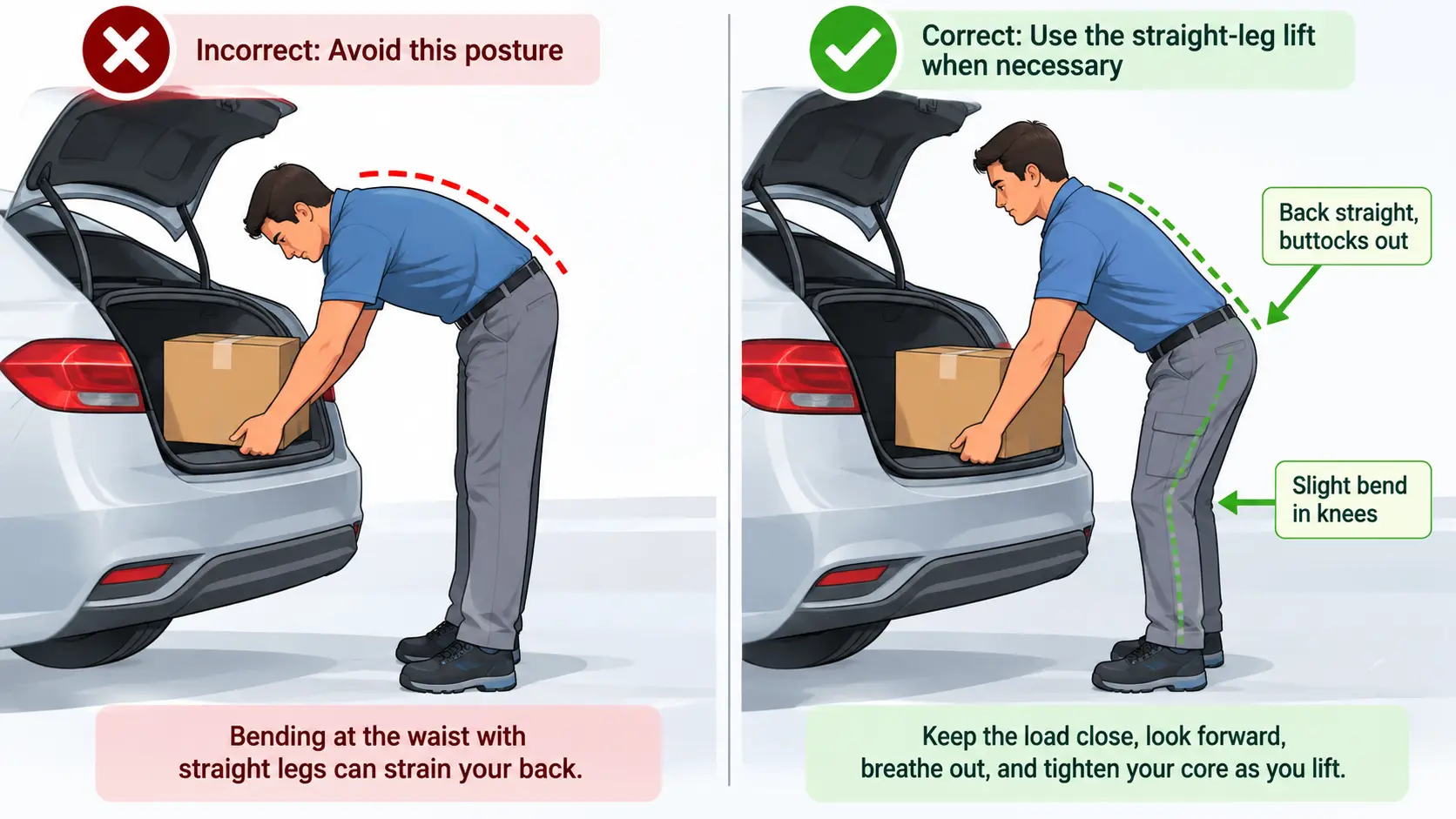
https://www.sfdph.org/dph/files/OSH/armylift.pdf (6)
Instead of locking your knees out straight, stand so that the knees can bend at least a little. Push your buttocks out and keep your back straight (yes, you can do this even if your knees are only bent a little). Try to drag the load as close as possible before you start the lift. Look forward, breathe out, and tighten your navel to your spine.
This is especially important when a load has to be moved from one location to another or when you pick up a load from a shelf and start carrying it. Most of the time, people plant their feet, pick up the load, and twist with their spines instead of moving their feet in the direction that they’re placing or carrying the load. The diagram below shows a better technique for moving the feet toward the direction in which you are moving.
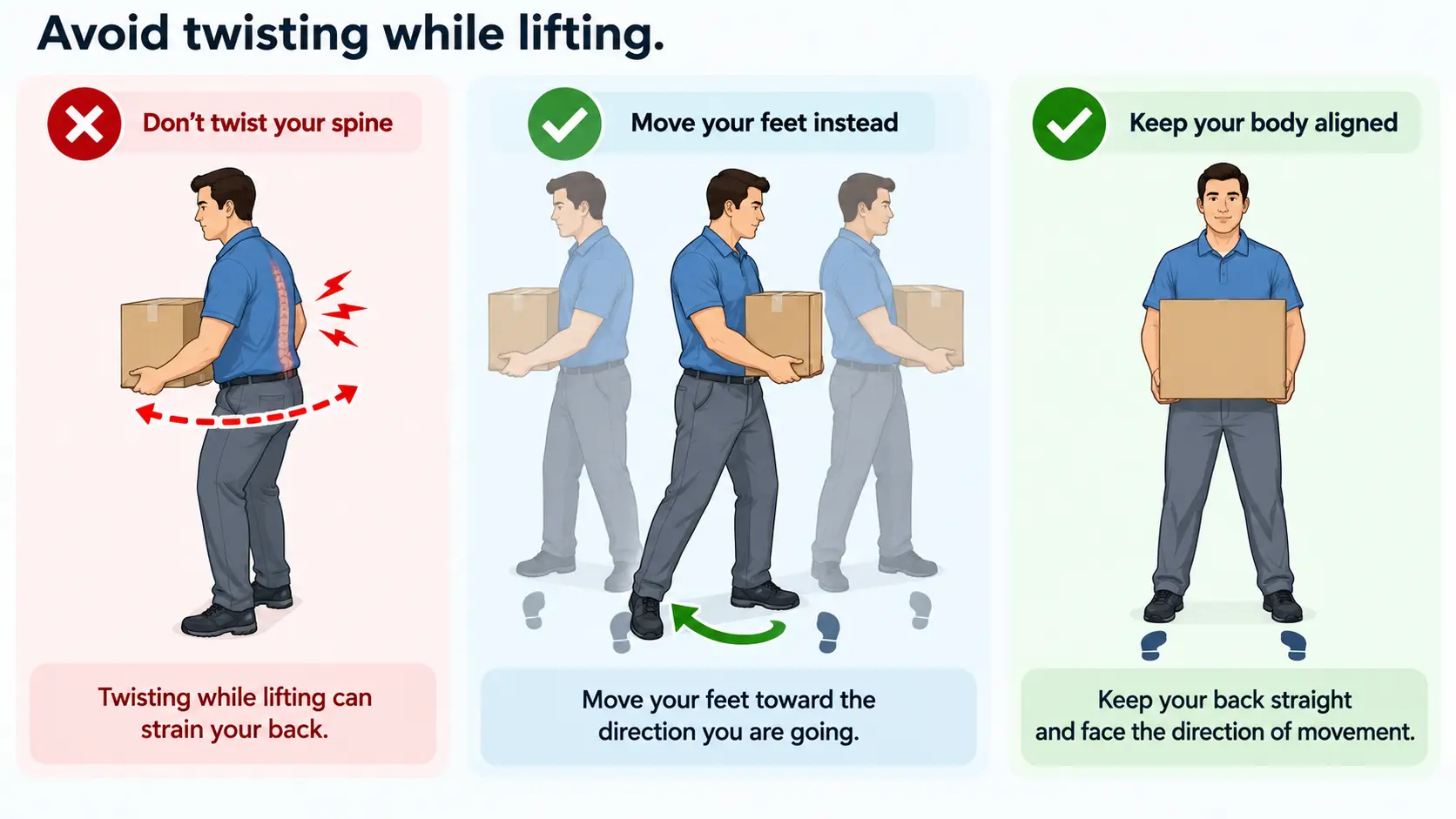
https://www.sfdph.org/dph/files/OSH/armylift.pdf (6)
In the example above, the worker moves the box from the right to the left. He holds the load close and turns the left foot 90 degrees towards the left. Simultaneously, he can pivot on the ball of his right foot during the turn, which takes the spinal twisting out of the movement. This is important because our spinal discs weren’t designed to tolerate twisting forces. The more we force them to twist under a load, the faster they will wear out or tear.
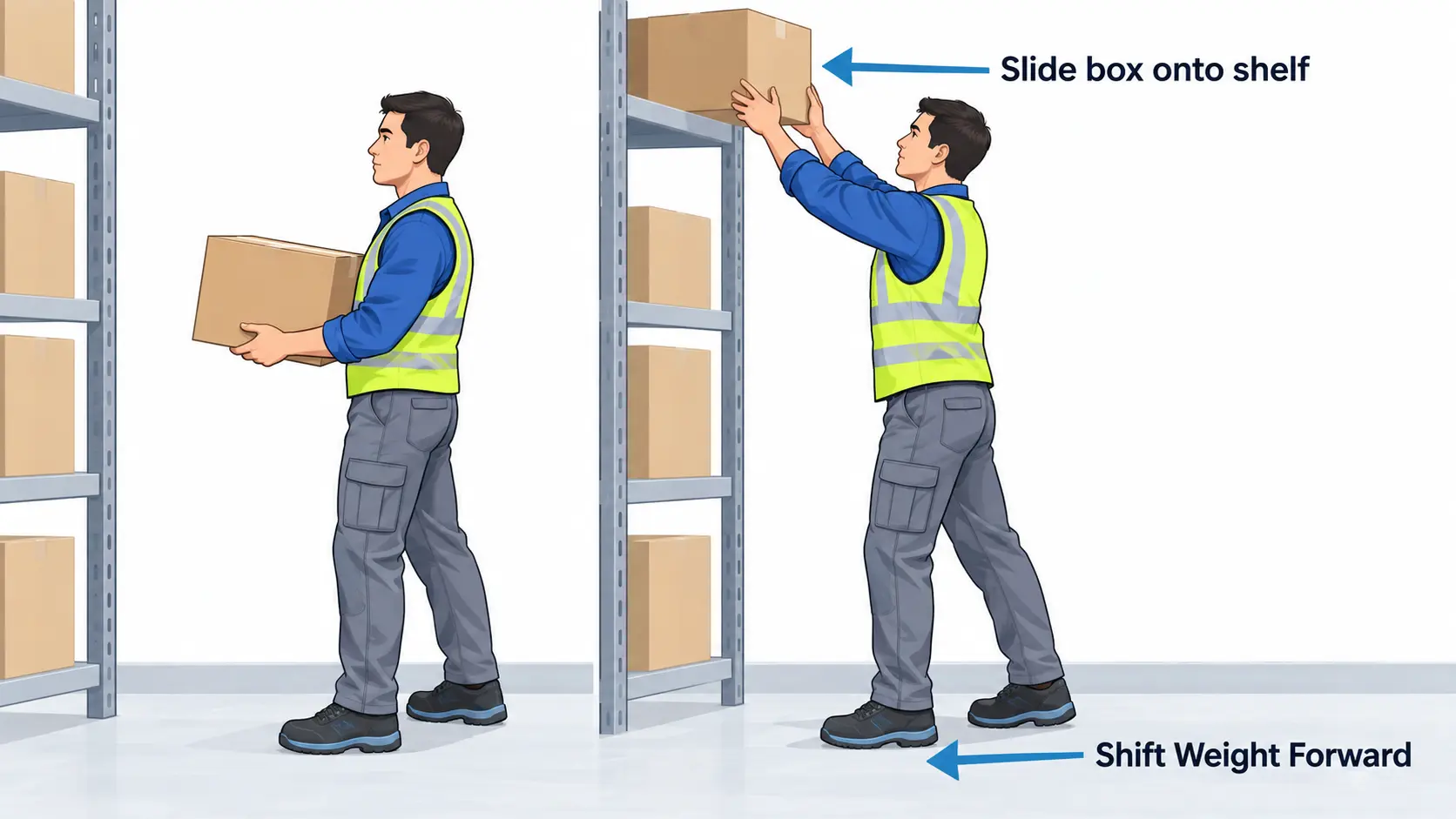
Above-shoulder lifting is especially stressful for your shoulders and wrists, putting significant compression forces through the spine. If the materials to be lifted can be moved to the “Golden Zone” (between knees and shoulders), the stress of the lift can be significantly reduced.
https://www.sfdph.org/dph/files/OSH/armylift.pdf (6)
The same principles for safe lifting below the waist apply to above-waist lifting: Keep the load close, keep feet shoulder-width apart and staggered, look forward and upward to the above-shoulder location, and breathe out as you lift with the navel pulled in.
As you reach the upper shelf, shift your weight toward the front foot, keeping your back straight throughout the lift. Once the front edge of the load is on the shelf, you can push it forward, reducing the overall load of the lift.
If the load is too bulky to fit safely between the knees or if the load is heavier than your abilities, then a two-person lift is required. With the two-person lift, designate one person to coordinate the lift who counts out loud to coordinate the lift. It is optimal if both people are about the same height and have similar strength.

When the same lifting problems keep appearing around the same task, the job itself may need closer evaluation. In these situations, employers should consider whether the task itself can be changed.
Depending on the job, potential interventions may include changing work height, repositioning materials, reducing reach distance, changing workflow, introducing lift-assist equipment, or modifying how materials are handled.
This does not make training unnecessary. Instead, it places training within a broader workplace injury prevention strategy. The objective is to make the job easier to perform correctly rather than relying entirely on the worker to compensate for a physically demanding task.
Despite lifting injuries accounting for about 1/3 of all non-fatal work-related injuries and costing employers over $60,000 in direct and indirect costs per lost-time injury, lifting or body mechanics training is often relegated to the back burner of safety training priorities.
Why? One of the reasons is that there are no compliance requirements for safe lifting training.
Most companies rely on live lectures or online training that is generic rather than tied to specific jobs. Training may occur at hire and be repeated annually, with limited follow-up to determine whether lifting behavior actually changes.
A stronger approach to workplace injury prevention connects training in ergonomic lifting techniques directly to the work employees perform. Instead of relying only on generic demonstrations, training can use actual job tasks, actual loads, task-specific observation, coaching, reassessment, and reinforcement.
This gives employees a clearer understanding of how ergonomic lifting techniques apply to the movements they perform every day. It also allows safety teams to identify whether a problem is related to technique, worker capability, or the demands of the task itself.
In our experience, this general/generic training does little to modify day-to-day, real-world lifting behavior. It’s a starting point to communicate the principles but needs to be followed by safety audits focused on materials handling.
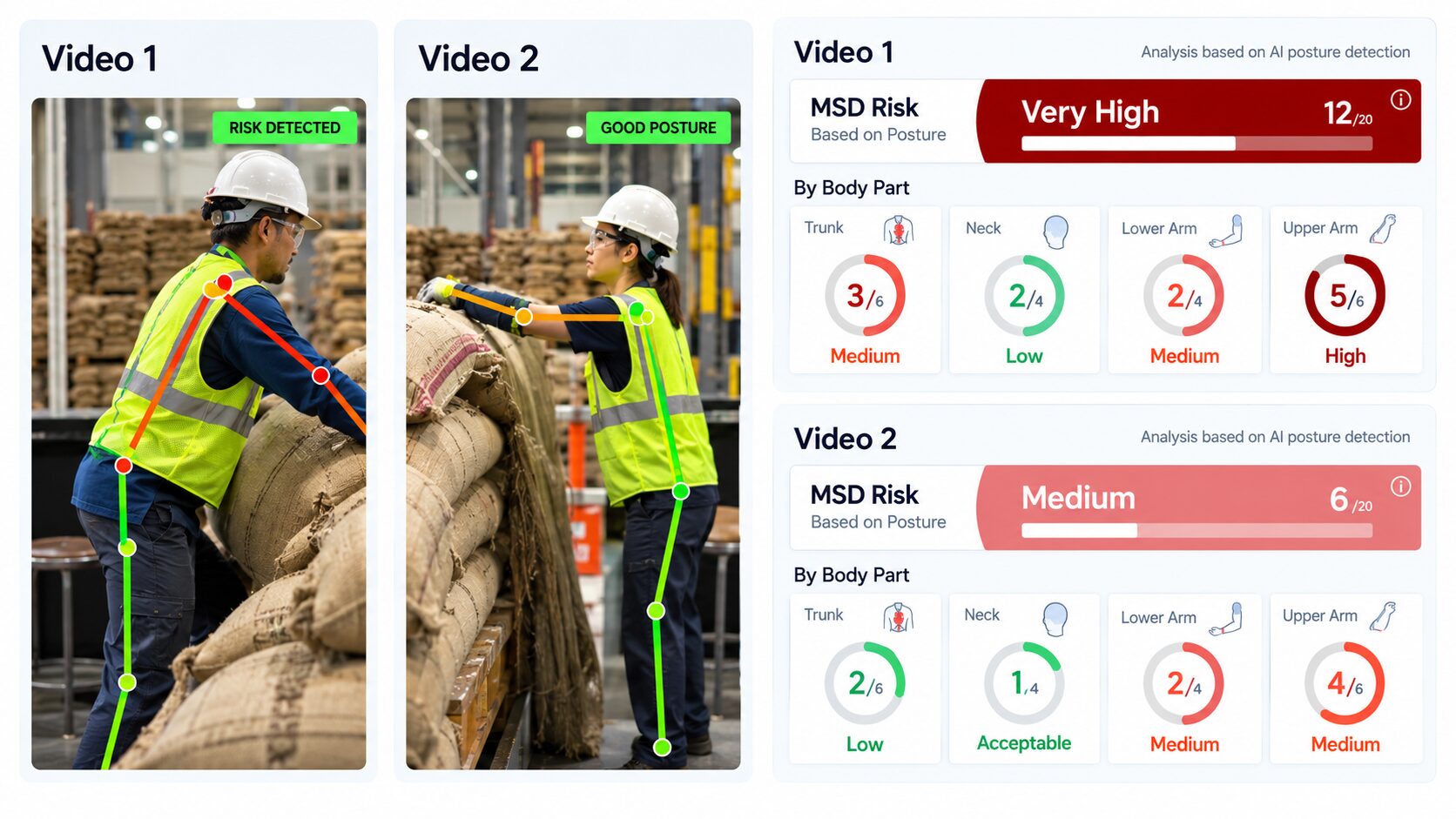
This is where technology can make lifting training more measurable. Using a camera-enabled device, safety professionals or supervisors can video employees as they perform the lifting tasks of their jobs. When the videos are uploaded to computer vision software, a hazard score is calculated in minutes. Sharing the videos and scores can be a great teaching tool. Employees see themselves as they perform the task and see the objective risk score associated with their performance.
The safety professional or supervisor can then coach the employee through better ergonomic lifting techniques specific to the employee’s strength, flexibility, and the task at hand. A second video of the improved technique can be used to compare hazard scores before and after the teaching session.
Compare that training approach to having the safety professional or supervisor observe the lifting and then begin coaching the employee. This observation approach feels much more subjective to the employee and has less credibility because the safety professional may have never done the task about which they are coaching.
In our experience, computer vision can make training more tangible by allowing employees to see their own movement patterns and compare changes over time.
When was the last time you learned a new sport and became proficient after one training session? That is essentially what one-time lifting training asks industrial athletes to do. Yet it is also unrealistic to expect a safety professional or supervisor to provide individual coaching throughout the day.
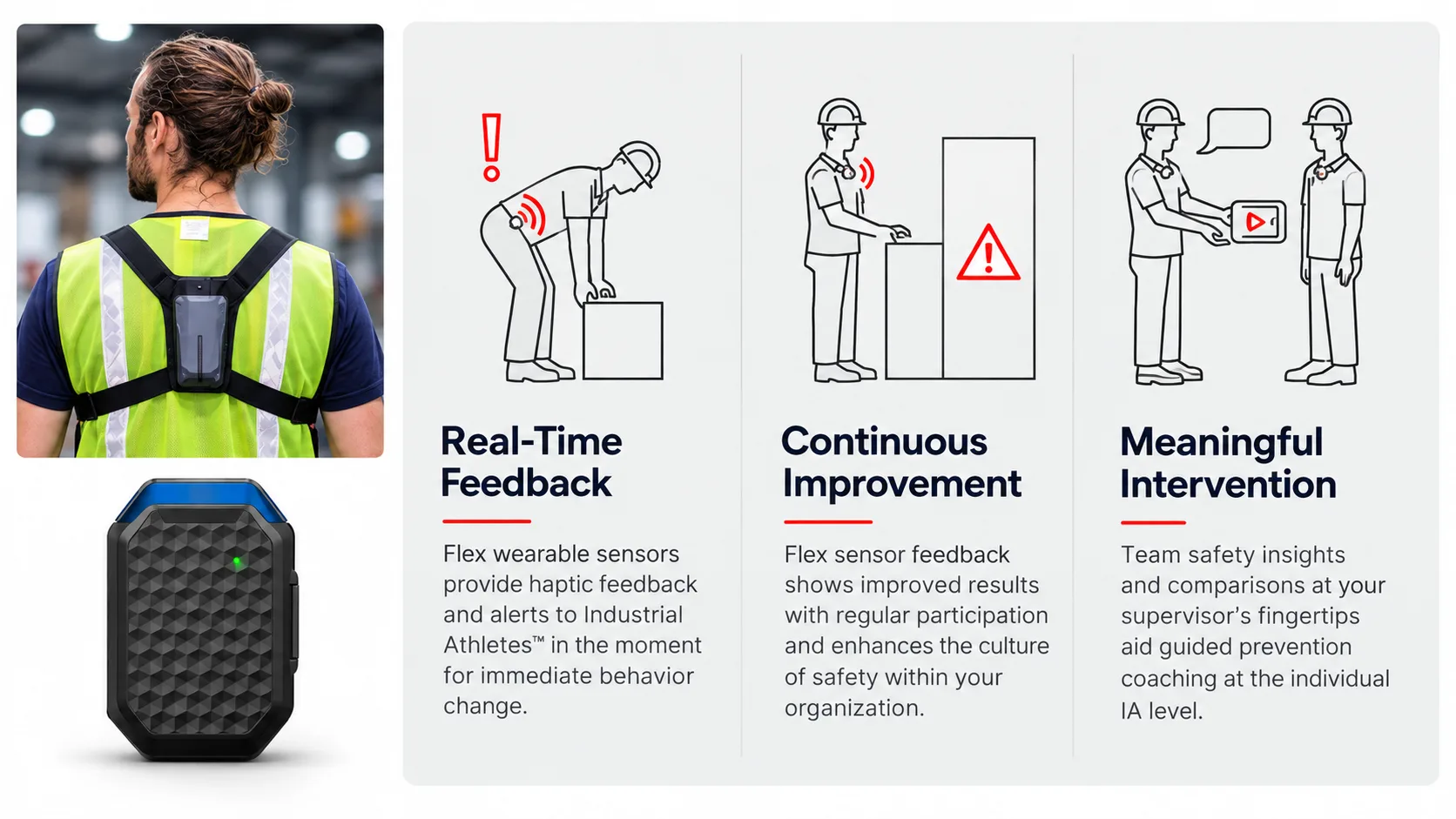
(10) Behavioral change requires practice and feedback, and changing lifting technique is no exception. However, practice with real-time feedback is rarely feasible in most work settings. According to an Industrial Safety and Hygiene News report, “the median ratio of EHS department staff members per 100 employees is 0.3 per 100, or about one EHS staffer for every 300 employees.” (11) Hardly a ratio that allows for individualized behavioral assessments and feedback.
However, wearable ergonomic sensors combined with customized microlearning video training change all that. Wearable sensor technology, a cutting-edge approach, has become a valuable tool for monitoring worker posture and trunk movement to combat MSDs. A 2021 study suggests sensor data can help identify faulty movement patterns and prevent low back injuries. Real-time alerting and leading indicator safety metrics allow frontline workers and their managers to intervene early and often when workers demonstrate patterns of poor body mechanics and/or lifting techniques.
Combining the sensors with digital micro-learning delivered directly to employees trains them to apply more nuanced and sophisticated lifting principles across all job tasks, including teaching employees the correct stance, correct use of core muscles, and proper foot placement.
Ergonomic wearable sensors provide haptic (vibration) feedback when the body bends too far forward during lifting and can be the “always-on” ergo coach. A variety of sensor configurations are available. (See figure below.) Data dashboards are sent to the supervisor or safety professional, who tracks whether workers improve their lifting technique.
Used over time, wearable technology can help reinforce lifting behavior and identify where additional coaching or intervention may be needed. If workers do not show improvement, further assessment and training can help determine whether the issue relates to worker capability, task demands, or both.
Perhaps the worker has physical limitations, which makes proper lifting difficult. Perhaps the task can be modified to make proper lifting easier.
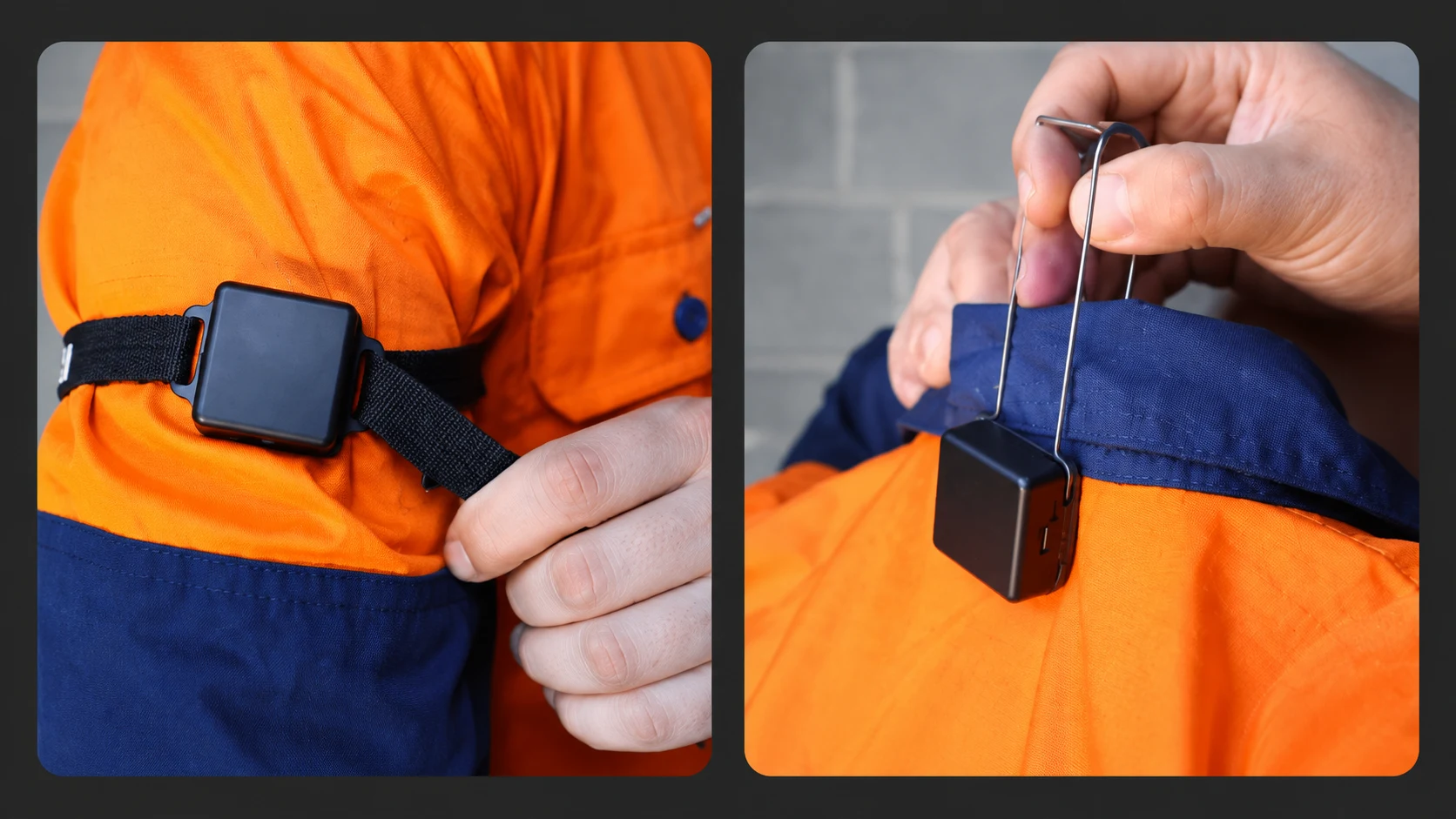
The important takeaway is that technology can help make lift training more measurable, reinforce behavior, and support sustained improvement.
Ergonomic lifting techniques matter, but effective workplace injury prevention requires more than teaching employees to bend their knees or keep their backs straight.
The right ergonomic lifting techniques depend on the worker, load, task, environment, and frequency of exposure. When those factors are considered together, organizations can address the conditions that contribute to lifting-related MSD risk rather than focusing only on worker behavior.
ErgoScience takes this approach a step further by combining job-specific assessment, research-backed lifting training, ergonomic intervention, and technology-supported observation.
For organizations looking to move from one-time lifting instruction to a more proactive approach to workplace injury prevention, the focus should be simple: understand the physical demands of the job, apply the right ergonomic lifting techniques, reinforce those behaviors, and measure whether they are working.
Identify the ergonomic risks in your lifting tasks and give your workforce the job-specific training to reduce them.
Get a job-specific ergonomic assessment and training plan built around how your workforce actually works.
Safe lifting goes beyond technique. Effective workplace injury prevention combines the right ergonomic lifting techniques with task assessment, training, reinforcement, and job design.
Ready to identify and reduce lifting risks across your workforce?
Employers can identify high-risk lifting tasks by assessing more than load weight. Ergonomic lifting techniques should be evaluated alongside lifting frequency, reach distance, lifting height, repetition, duration, twisting, load characteristics, and workspace constraints. Observing employees perform actual job tasks can help identify where physical demands are highest. This task-specific approach supports workplace injury prevention by helping employers determine which lifting tasks require training, ergonomic intervention, or job redesign.
A lifting task should be redesigned when physical demands remain high despite employees using appropriate ergonomic lifting techniques. Employers can consider reducing reach distance, changing work or storage height, repositioning materials, modifying workflow, or introducing lift-assist equipment. Workplace injury prevention is more effective when organizations address the physical demands of the job instead of relying entirely on employees to compensate through improved lifting technique.
Lifting training teaches employees how to apply ergonomic lifting techniques, while an ergonomic assessment examines the physical demands of the task. Training focuses on movement and body mechanics; an assessment considers factors such as force, repetition, reach, posture, equipment, and workstation design. Both can support workplace injury prevention, but they address different parts of the lifting-related risk.
Employers can measure lifting training by assessing whether employees apply ergonomic lifting techniques during actual job tasks and whether observed risk improves over time. Computer vision can provide objective risk scores, while before-and-after assessments can show changes in lifting behavior. Ongoing observation and feedback can further support workplace injury prevention by identifying whether training is producing measurable improvements.